


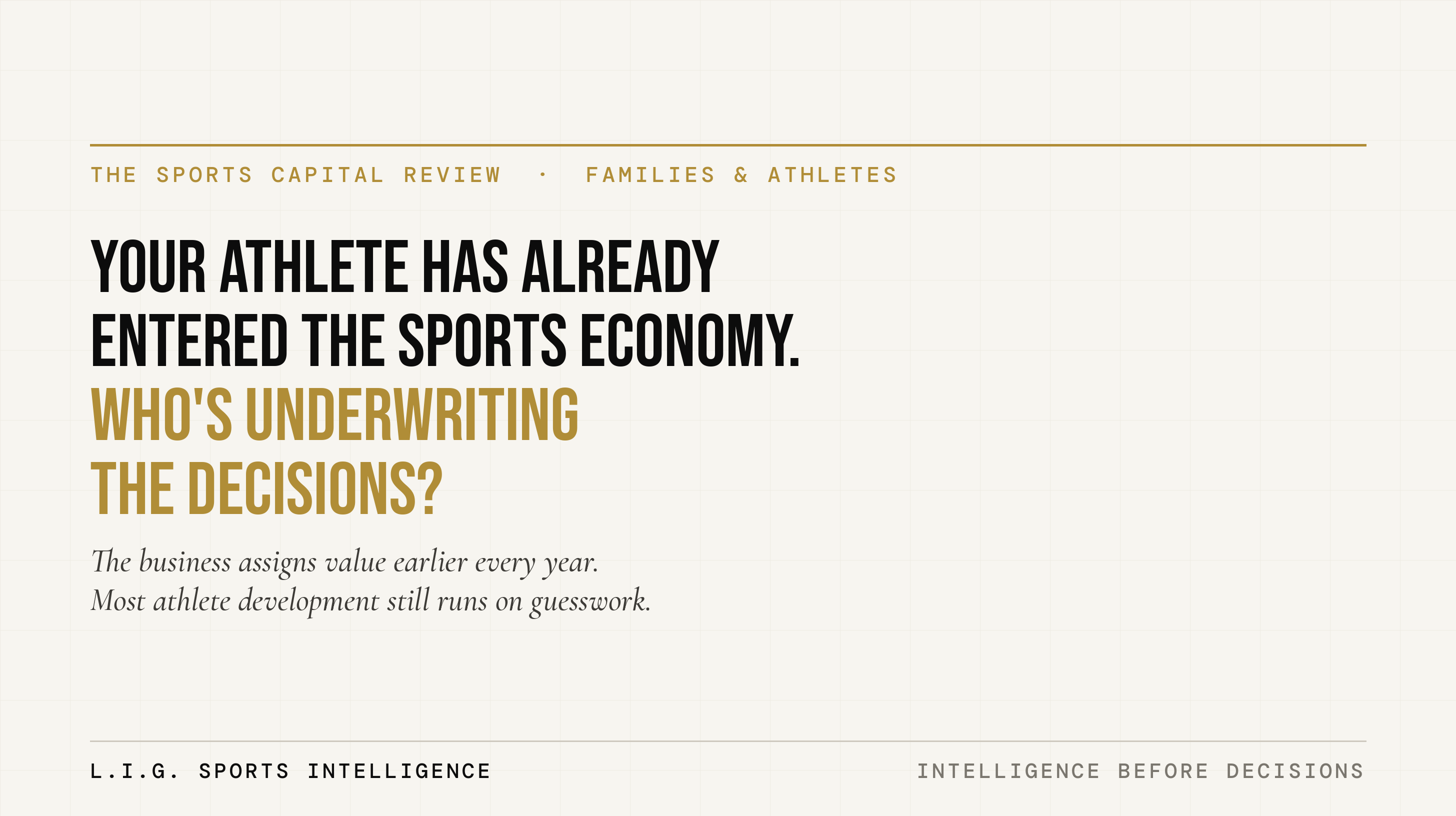
The business is formalizing. The athlete’s development has to catch up.
A young athlete can have an impressive recruiting profile, a private speed coach, a technical trainer, a stack of showcase invitations, and an agent promising exposure.
And still have no real idea where they actually stand.
That’s the contradiction at the center of youth sports right now. Families have access to more services, more information, more training, and more recruiting platforms than any generation before them. But access to services isn’t a strategy. It’s just a bigger bill.
The industry sells development in pieces. Someone sells speed. Someone sells skill. Someone sells exposure. Someone sells access to a college program.
Nobody’s responsible for making sure those investments actually work together.
And that question gets more expensive every year the economics of college sports change.
After the House v. NCAA settlement, participating Division I schools now operate under a framework that permits direct athlete compensation and replaces sport-specific scholarship limits with roster limits. The proposed Protect College Sports Act would layer federal rules on top, governing NIL, athlete protections, compensation, and governance. As of late September 2026, the bill has advanced in the Senate but hasn’t completed the process.
This isn’t a recruiting market anymore. It’s a formalizing sports economy.
And the families walking into that economy need more than someone who knows a coach.
They need a way to evaluate the asset, understand the risk, find the real opportunity, and make informed decisions before they commit serious time and money- a process that starts long before an athlete ever gets an offer.
1. Speed has value. Being a mover has more, and the market pays for it.
Speed is one of the most valuable traits in sports, and it’s worth being precise about why. It isn’t just that fast athletes win more. Speed drives almost every number the business actually cares about.
Speed sells tickets and sponsorships; the breakaway, the closing burst, the highlight that travels is what fans pay to watch, and brands pay to attach to. It changes outcomes: separation creates scoring, erases mistakes, and shows up directly in win shares and the margins that decide games. And it quietly protects value where nobody thinks to look — a 320-pound lineman’s ability to run, redirect, and absorb load is a durability signal, and durability is the single biggest driver of whether a long-term investment in that athlete pays off. Speed touches revenue, results, and risk at the same time. That’s why the market prices it.
You don't have to take my word for how the market values this. In 2026, adidas built an entire national football campaign around a single phrase: Speed Is Money, casting an NFL veteran Chad ‘Ochocinco’ Johnson as a "speed broker" rounding up the fastest names in the game. When the biggest brand in the sport spends marketing dollars to tell you speed is money, it isn't making an athletic point. It's making a market one. Speed moves product, moves audiences, and moves value, and everyone in the business already knows it.

But the industry made it easy to sell a number instead of the trait. A 40 time. A 10-yard split. A sprint result. A ranking.
Those numbers have value: they’re measurable evidence of physical capacity. But they don’t tell you whether an athlete can actually move.
A football player can run a great 40 and still struggle to transition, change direction, or react when the picture changes. A soccer player can have straight-line pace and no ability to decelerate, reposition, and accelerate into space. A tennis player can have elite foot speed and still arrive late every time, because the anticipation and first step aren’t there.
All three are fast. None of them are necessarily effective movers.
There’s a real difference between developing speed and developing an athlete who can express it—the second requires physical capacity, technical efficiency, perception, and decision-making all working together. That’s where value separates, because elite movers add value in every sport and at every level: the lineman who stays healthy, the guard who closes out, the winger who beats the last defender, the shortstop who turns the extra step into an out. Straight-line speed is a trait. Movement is an asset. And as competition rises, the question shifts from what an athlete shows in a controlled test to what they can repeat against a live opponent—which is exactly what the test never measured.
Speed gets attention. Movement creates advantages. Expression is what the market actually pays for.
But even a valuable trait needs the right development plan.
2. All development is not equal. Neither is the money spent on it.
Development usually gets sold as one thing: train harder, get stronger, sharpen your skills, compete. In reality, a real development pathway has three distinct parts that must work together — and most families buy only one or two without knowing it.
The foundation — athletic development. Speed, strength, power, mobility, coordination. The physical capacity to compete.
The craft — technical development. Sport-specific mechanics, footwork, positioning, and consistent skill execution.
The application — expression development. Turning the physical and technical into actual performance: perception, decision-making, adaptability, execution against real competition.
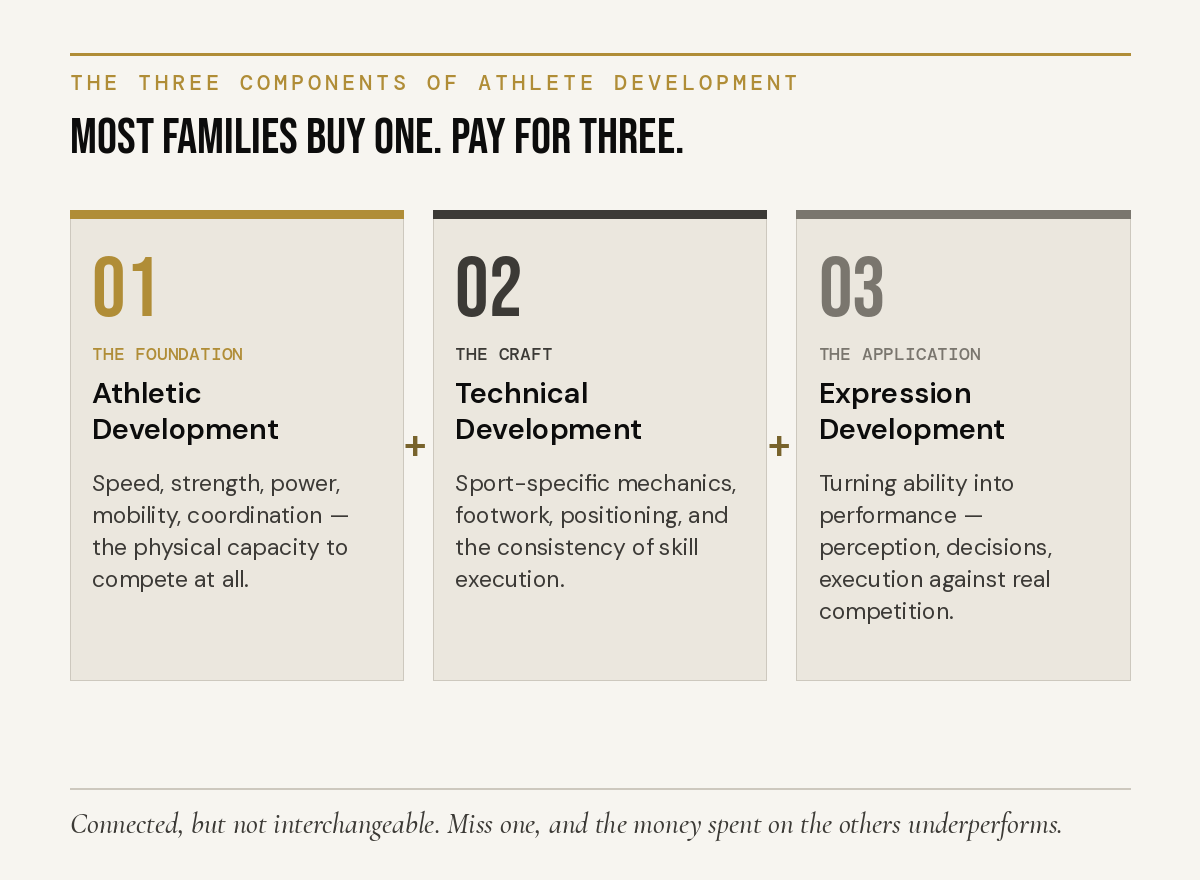
These are connected, but they are not interchangeable. An athlete can spend thousands on technical training without the athletic foundation to execute it. Another can build exceptional physical tools with no technical proficiency to apply them. A third can dominate in training and never translate it to a game.
None of that automatically means the training was bad. It usually means the development was incomplete, poorly sequenced, or disconnected from what the athlete actually needed.
Here’s where the business model creates the problem. A speed coach is paid to sell speed. A skills trainer sells skill. A showcase sells a chance to be seen. An academy sells its program. Each may deliver real value, and none is responsible for evaluating the whole athlete or telling you whether this particular investment is right for you right now.
So the family becomes the de facto general manager, trying to coordinate a dozen specialized vendors with no independent evaluation framework. And when the athlete stalls, the industry’s answer is always the same: another service. Another camp. Another trainer. Another showcase. More spending, not more clarity.
We look at development as an investment process. The goal isn’t to pile up more activity — it’s to find the few development priorities that would actually change the athlete’s competitive standing and future opportunities. And you can’t do that without first understanding the athlete’s current ability, trajectory, competitive environment, academic profile, and realistic college market.
You cannot build an effective development plan without first understanding what you’re developing toward.
3. The college-sports fight reveals a bigger pipeline question
While families navigate the youth market, college athletics is restructuring its own economics, and the Protect College Sports Act is a useful window into it. The bill proposes a national framework for NIL rights, compensation, eligibility, and governance, with provisions meant to protect women’s and Olympic sports—participation opportunities and retention spending tied to non-revenue programs.
It’s contested. Supporters point to stability, national standards, scholarship protection, and the preservation of non-revenue sports. Critics, including athlete-rights and labor advocates, raise concerns about compensation limits, NCAA authority, antitrust protection, and how much athlete representation the framework really allows. Those are real questions about how the college business runs.
But there's a question underneath the legislation that nobody is regulating — and it's the one that decides who actually gets to participate:
What happens to the development pipeline before an athlete ever reaches college? And who can afford to enter it?
Look closely at how the money is being allocated, and a quiet exclusion appears. The legislation spends its energy protecting existing college opportunities: roster spots, participation lines, retention dollars for programs already standing. Worthwhile. But protecting the top of a funnel does nothing for the cost of entering the bottom. And the bottom of the funnel is where the real gate is.
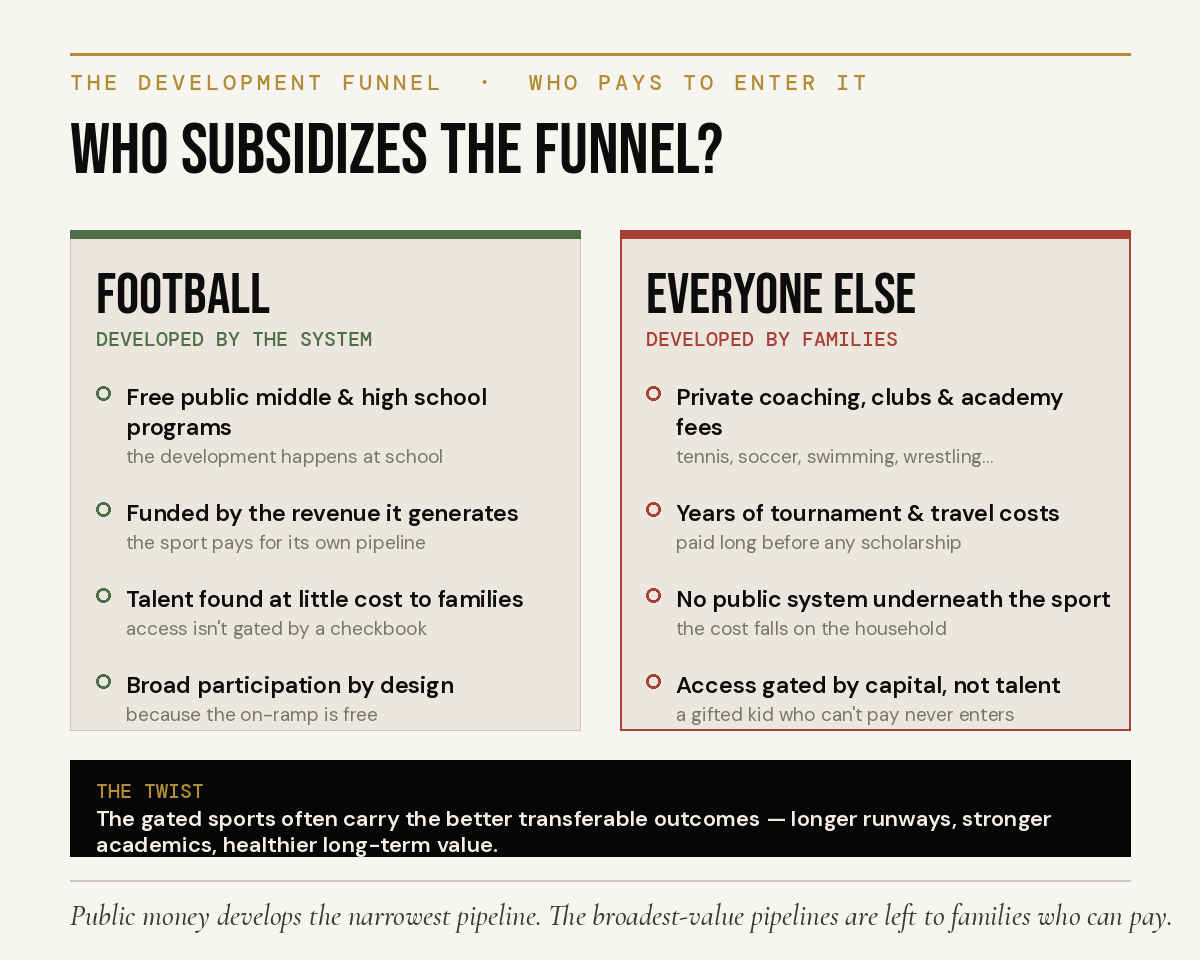
Consider what it actually takes to develop a college-caliber athlete in most sports. Tennis runs on private coaching, tournament travel, and academy fees. Soccer runs through club and academy systems that bill by the season. Swimming, wrestling, track and field, lacrosse, squash — each one asks a family to fund years of coaching, competition access, and travel long before a scholarship is ever on the table. The pathway isn’t gated by talent. It’s gated by capital. A gifted kid whose family can’t fund the pipeline never reaches the college opportunity the legislation is so focused on protecting.
Now hold that against the one sport built differently. Football is, in practical terms, the only sport substantially subsidized by the education system itself, developed inside free public middle and high school programs, funded by the athletic-department revenue it generates. A talented kid can be found and developed at essentially no cost to the family. That access is exactly why football produces the participation it does. It’s also why the funnel for nearly every other sport looks so different: no free public development system underneath it, so the cost falls on families, and the sport quietly becomes a game for those who can pay to play.
Here’s why that should matter to anyone writing sports policy: gated sports often have better transferable outcomes. The non-revenue and Olympic sports —tennis, soccer, swimming, wrestling, track, squash, lacrosse—tend to offer longer athletic runways, stronger academic and international pathways, healthier long-term earning and life outcomes, and lower catastrophic-injury profiles than the collision sport doing most of the subsidizing. As a system, we are spending public money to develop the pipeline with the narrowest transferable value, while leaving the pipelines with the broadest transferable value to whichever families can afford them.
The pathway isn’t gated by talent. It’s gated by capital. And the sports we gate hardest are often the ones with the most to offer.
So the legislation’s instinct —to protect participation—is right. Its aim is incomplete. Protecting a college opportunity an athlete can’t afford to reach is protecting a door most families were never given the keys to. If the goal is genuinely more opportunity, the investment has to move earlier: into affordable development, public and community coaching, competition access, and the on-ramps that let a talented kid enter these sports without a five-figure annual bill. Squash is a live example of exactly this tension — as it enters the LA 2028 Games, US Squash has named public access, youth participation, and coaching as growth priorities, because the sport’s leaders understand that protecting the college programs at the top means nothing if no new families can afford to reach them. Building the funnel and protecting the finish line are related goals, but they are not the same investment; and right now, almost all the attention is on the finish line.
What does sSuccesslook like? A development system where opportunity tracks talent instead of tracking a family’s checkbook — where the public investment flows toward widening the funnel in the sports that reward it most, not just fortifying the exit.
Until that system exists, families must navigate the gap on their own — and that gap is precisely where an uninformed decision gets expensive. Which means understanding a sport’s economics is no longer optional. It’s now part of understanding an athlete’s development and recruiting pathway — which sport rewards the investment, which pathway fits the athlete, and where a dollar of development actually buys a future instead of a season. That’s the information families rarely get, and it’s what we’re built to provide: an independent view of he athlete and the market they’re trying to enter, before they commit capital. We can’t fix the funnel. We can make sure a family isn’t pouring years and dollars into the wrong end of it.
A talented athlete can still chase the wrong market. And a family can invest heavily in a pathway that never aligned with the athlete’s actual opportunities.
4. The industry has brokers. Families need independent intelligence & guidance.
Think about buying a house.
The real estate agent finds properties, runs the negotiation, and closes the deal. But before you commit that kind of money, you want more than the agent. What’s the property's real condition? What problems aren’t visible on the walkthrough? What needs repair? Does the price hold up against the market? What could hurt its future value?
That’s why buyers hire inspectors and appraisers. Their job differs from the transaction, and that difference is the point.
Now look at the athlete advisory market. An agent can help secure a deal, negotiate compensation, or connect an athlete to an opportunity. A good one adds real strategic value. But representation and independent evaluation are not the same function.
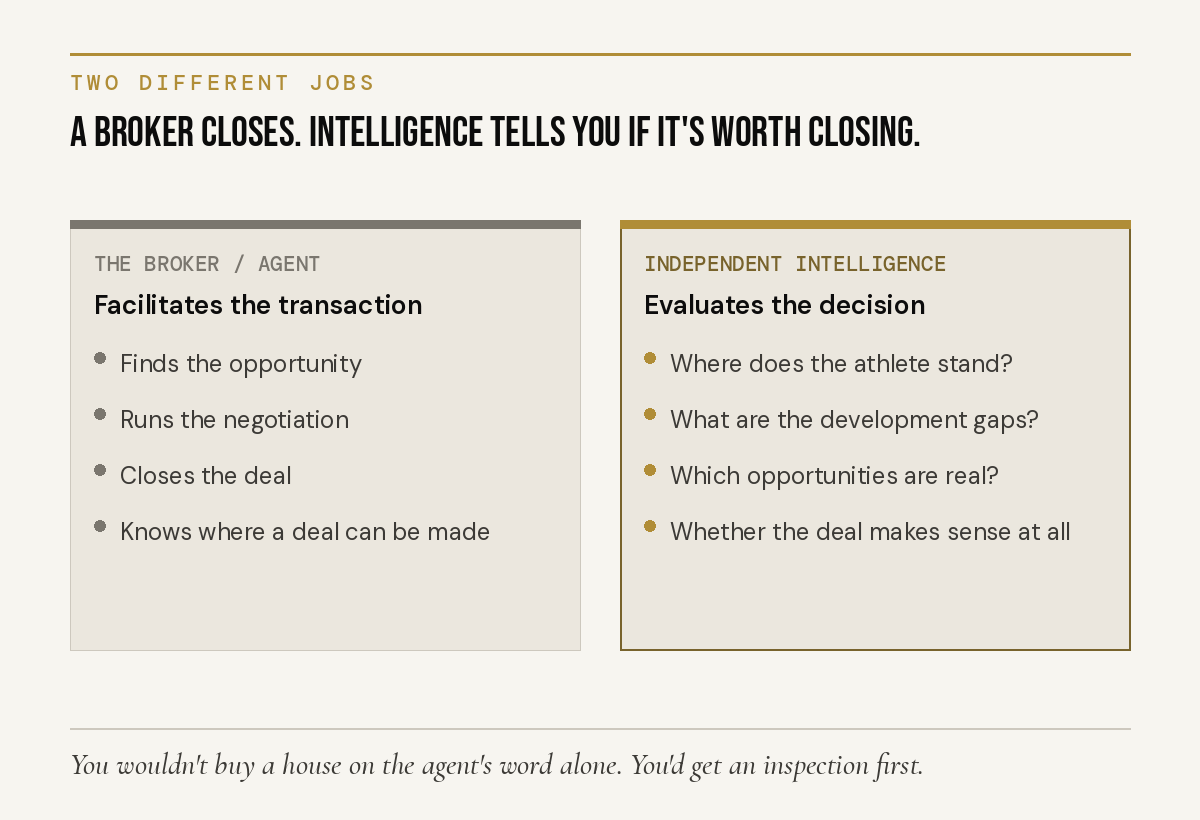
An agent can tell you where a deal can be made. An independent advisor should tell you whether that deal makes sense in the first place.
For a young athlete, that distinction can decide everything. Before committing to a training program, chasing a particular conference, accepting an offer, or signing with representation, a family needs to understand the fundamentals: Where does the athlete objectively stand? What separates them from their peer group? What development gaps are shaping their trajectory? Which schools fit their athletic and academic profile? What’s realistic — and what’s the risk in pursuing it?
Those questions take more than relationships. They take evaluation, context, planning, and a willingness to tell a family something they may not want to hear. How can you go into a deal not knowing where your leverage and real exposure exist?
A broker helps close a transaction. But a transaction isn’t a sound decision; and knowing where a deal can be made isn’t the same as knowing what the athlete is worth.
That’s the piece everyone skips. The athlete market runs on supply and demand, not demand and relationships. Position scarcity, replacement cost, where this athlete actually stands against their peer group , that’s the intelligence a real negotiation is built on. A relationship gets you in the room. The data determines what happens once you’re there.
Anyone can help a family chase an opportunity. Far fewer can tell them which opportunities are worth chasing … and fewer still can hand them the leverage to negotiate it. That’s the most valuable position in the entire equation, and it’s the one almost nobody occupies.
5. Blueprint to Success: underwriting the athlete before the market does
That’s the thinking behind Blueprint to Success, our independent athlete evaluation and recruiting advisory program.
We built it on a simple principle: athletes and families deserve a structured process for the biggest development and career decisions they’ll make. So instead of opening with a promise of exposure or access, we open with evaluation: the athlete’s current competitive standing, athletic and technical development, academic position, recruiting status, and market opportunities. Then we identify the gaps between where the athlete is and where they’re trying to go.
The framework runs on four proprietary instruments:
Athlete Asset Score™- a composite view of the athlete’s overall development and positioning. Position Value Index™ — competitive standing and market position relative to their position and projected level. NIL Readiness Score™ — commercial readiness, where it’s relevant to their stage. L.I.G. Athlete Risk Matrix™ — the factors that could affect development, recruiting, or career decisions.
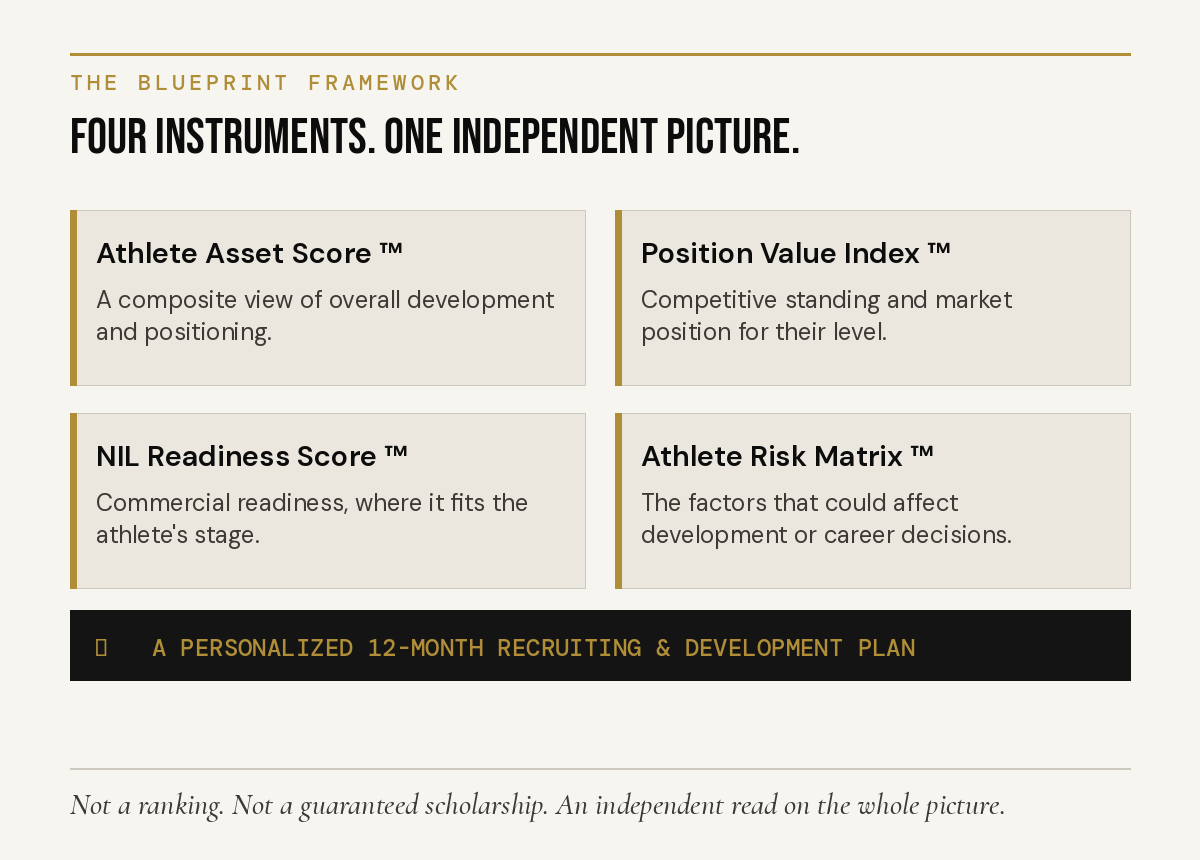
Those assessments feed a personalized 12-month recruiting and development plan: development priorities, academic planning, school targeting, film and measurable benchmarks, and ongoing advisory support.
The goal isn’t to manufacture a recruiting ranking, guarantee a scholarship, or replace the coaches and specialists already working with the athlete. It’s to give families an independent view of the entire picture, so they can make better decisions about the resources, relationships, and opportunities they pursue.
We don’t take a percentage of an athlete’s future earnings. Our business is the evaluation and intelligence families need to make better decisions, because development is an investment, recruiting is a market, and an athlete’s career is too consequential to manage through disconnected transactions.
The bottom line: the business is formalizing. Families should too.
The sports business no longer waits until an athlete turns pro to assign economic value to their ability. That process moved earlier. Physical traits create market interest. Technical proficiency shapes competitive positioning. Expression determines how consistently it translates into performance. And the development pathway decides whether the athlete keeps progressing as competition rises.
Meanwhile, college sports are rebuilding how money, roster spots, and opportunities get allocated. The cost of an uninformed decision isn’t a disappointing season anymore. It’s lost development time, serious family spending, missed educational opportunities, or years chasing a market the athlete was never positioned to win.
The industry is getting more sophisticated about how it evaluates and allocates capital. Families need to bring the same discipline to their own decisions.
Stop confusing activity with development. Stop confusing exposure with opportunity. Stop confusing access with intelligence.
Your athlete has already entered the sports economy. The only question is whether you’re managing their development and career with the same discipline the business now demands.
That’s where Blueprint to Success begins.
L.I.G. SPORTS INTELLIGENCE
Know where your athlete stands. Build what comes next.
Blueprint to SSuccessprovides independent athlete evaluation, development intelligence, and a strategic 12-month recruiting plan. Before you invest in the next opportunity, understand what your athlete actually needs.
Explore Blueprint to Success →
PW: Blueprint
Independent intelligence before the next decision.