


For decades, the sports industry understood when an athlete became a financial asset.
It happened near the end of the athlete’s competitive journey.
An NFL prospect preparing for the Draft purchased disability insurance. A projected first-round NBA pick hired financial advisors. An MLB prospect negotiated a signing bonus. Professional clubs evaluated long-term contractual risk.
Underwriting happened then because the market had already accumulated years of evidence.
Film. Production. Medical history. Athletic testing. Competitive performance.
The uncertainty had narrowed. The athlete had become an observable asset.
Today, that sequence no longer exists.
The money moved. The intelligence didn’t.
And that gap is no longer theoretical. It is already producing lawsuits, coverage disputes, and structural losses across college sports.
THE FINANCIAL TIMELINE HAS CHANGED
NIL. Revenue sharing. The transfer portal. Private academies. Elite club systems. Global development pathways.
Every one of these accelerated the athlete economy.
Capital now enters an athlete’s life years before professional sports.
Athletic departments deploy significant financial resources into roster construction. Collectives invest in retention. Families make six-figure development decisions. Brands begin partnerships while athletes are still developing. Insurance conversations begin sooner. Banks are exploring products tied to future athlete earnings.
The athlete is no longer simply developing.
The athlete is becoming an economic asset.
The financial timeline moved. The evaluation process largely stayed where it was.
THE COURTS ARE ALREADY DECIDING WHAT THE INDUSTRY WON’T
If you think athlete-as-asset is a metaphor, the federal court system disagrees.
In 2024, the Third Circuit ruled in Johnson v. NCAA that college athletes are not categorically barred from being classified as employees under the Fair Labor Standards Act. The court didn’t declare athletes employees. It did something more consequential: it stripped away amateurism as a legal shield and sent the question back down with a test built on economic realities.
Read that phrase again. Economic realities.
A federal appeals court has instructed the industry to evaluate athletes the way markets evaluate economic relationships — not the way tradition evaluated amateurs.
The case is now back in district court, and the judge has ordered the parties to report on settlement efforts. Meanwhile, the House settlement was approved in 2025, and schools began sharing revenue directly with athletes. Duke has sued its former quarterback in a dispute that reads like an attempt to enforce a noncompete agreement. These are not eligibility questions. These are employment and contract questions.
Now follow the chain.
If athletes are employees, wages follow. Workers’ compensation follows. Collective bargaining follows. And the NCAA’s compensation rules stop looking like eligibility conditions and start looking like hundreds of competing employers agreeing to cap pay — the kind of arrangement antitrust law was written to destroy.
Every institution in college sports is carrying this exposure right now.
Almost none of them can tell you what it’s worth.
That is an underwriting failure. Not a legal one.
THE INSURANCE MARKET ALREADY RAN THIS EXPERIMENT. IT FAILED.
Here is the part of the story almost nobody in college athletics talks about.
The market already tried to price athlete risk without a valuation standard.
Loss-of-value insurance flooded college sports in the 2010s. Elite prospects bought policies designed to pay out if injury dropped their draft position. It sounded like underwriting.
It wasn’t. It was speculation wearing underwriting’s clothes.
Nobody could agree on how to measure the value that was lost. Policyholders and carriers fought over projections. Disputes ended up in court. Michigan tight end Jake Butt reportedly collected roughly $543,000 on his loss-of-value policy after an injury in his final college game. USC receiver Marqise Lee — a similar profile, a similar draft slide — collected nothing, and his claim dispute with underwriters landed in litigation.
Two elite prospects. Two policies. Two injuries. Opposite outcomes.
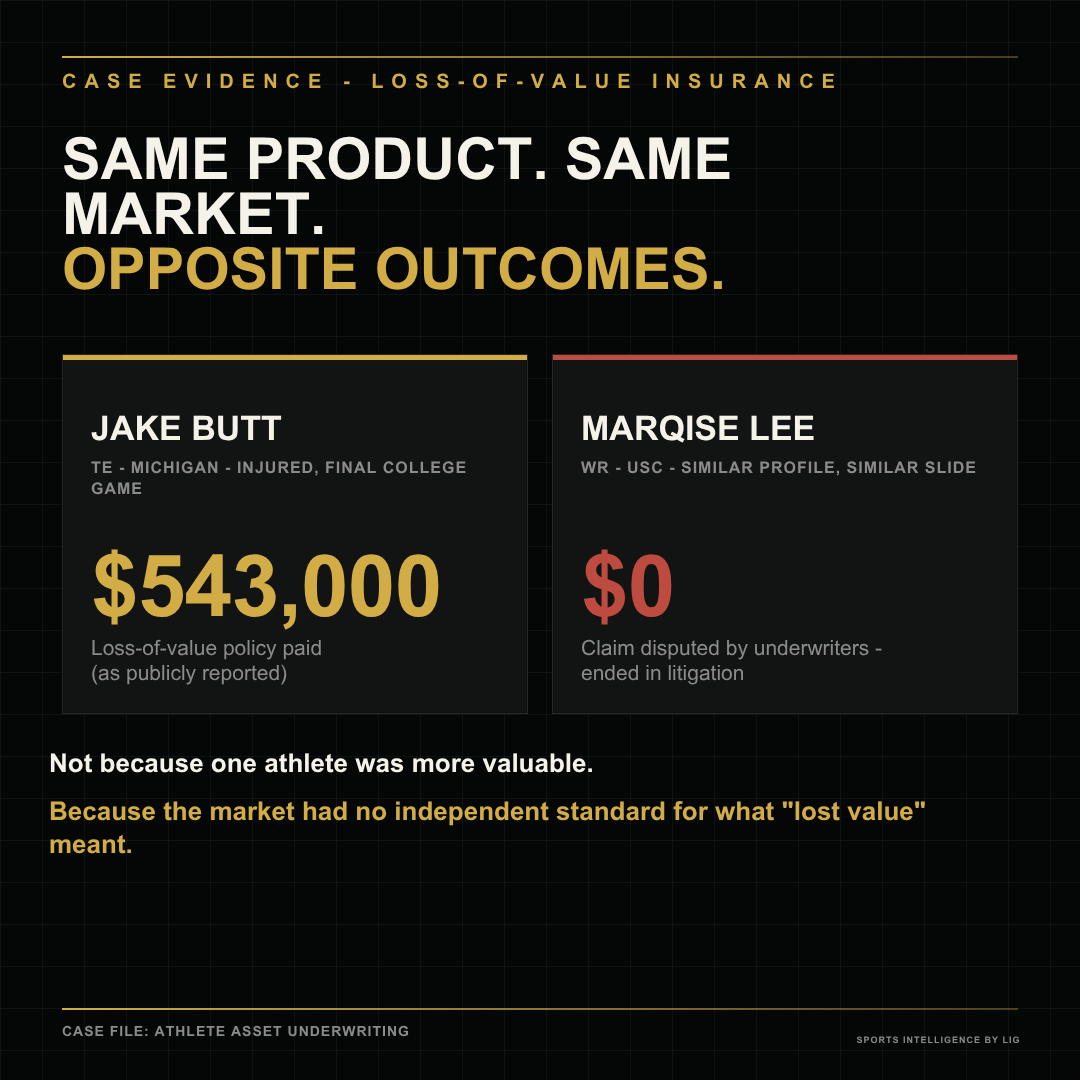
Not because one athlete was more valuable. Because the market had no independent standard for what “lost value” meant.
Carriers responded the way capital always responds to unpriceable risk. They cut capacity. Cover holders who once wrote eight figures were restricted to a fraction of it. The product bottomed out.
The lesson was never that athlete risk can’t be insured.
The lesson was that you cannot build financial products on top of valuations nobody agrees on.
And now the market is repeating the mistake at a larger scale. NIL income has created an entirely new exposure class: injury-related income loss, reputational harm, contract litigation, and Title IX disputes tied to the distribution of NIL opportunities. Actuaries are publicly warning that traditional insurance models were not built for this terrain. Collectives have faced high-value disputes without liability coverage. Universities are carrying board-level exposure for deals they don’t monitor.
The exposure exists. The intelligence to price it does not.
That gap has a cost. The question is only who pays it — and when.
RECRUITING WAS NEVER DESIGNED FOR THIS ECONOMY
Recruiting answers one question.
Can this athlete help us compete?
That question still matters. But it is no longer enough.
Today’s marketplace requires another question.
Should we invest?
Those are fundamentally different disciplines.
Recruiting identifies talent. Underwriting evaluates investment. Recruiting measures athletic ability. Underwriting measures uncertainty. Recruiting helps acquire athletes. Underwriting helps allocate capital.
A recruiting department can tell you an athlete runs a 4.4.
It cannot tell you what happens to your capital position if that athlete is reclassified as your employee, tears an ACL in year two, and holds an NIL portfolio your institution never evaluated.
That is not a knock on recruiters. It is a recognition that the job changed underneath them.
WELCOME TO THE ERA OF SPORTS CAPITAL MANAGEMENT
Something much larger is happening beneath the surface.
Athletic departments aren’t simply managing teams anymore. They’re managing capital.
Scholarships. Revenue-sharing pools. NIL allocations. Roster spots. Transfer investments. Development resources. Retention budgets. Legal exposure. Insurance exposure.
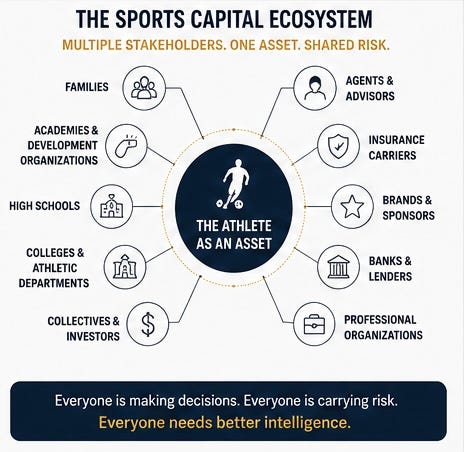
Every one of those decisions represents capital deployed against an athlete asset.
Whether they call it that or not, athletic departments, collectives, agencies and institutions are already practicing Sports Capital Management.
The difference is that most are doing it without a standardized underwriting discipline.
Athletic directors are no longer just responsible for competitive success. They are allocating finite institutional resources against assets whose legal status is being litigated in real time.
General managers aren’t just acquiring talent. They’re making portfolio decisions.
Families are making investment decisions. Brands are making investment decisions. Insurers are evaluating financial exposure. Lenders are modeling future earnings.
Every stakeholder is interacting with the same athlete.
Every stakeholder carries risk.
Very few are speaking the same language.
THE ATHLETE LIFECYCLE HAS BECOME ONE CONTINUOUS UNDERWRITING EVENT
One of the biggest misconceptions in sports is that underwriting begins when an athlete approaches professional sports.
That made sense when financial exposure arrived late. It no longer does.
Today, underwriting begins whenever meaningful capital enters the athlete’s journey.
A soccer player choosing between a local club and an academy. A tennis player transitioning into full-time development. A baseball player entering national showcase circuits. A football player selecting a developmental environment before recruiting accelerates the process.
The athlete doesn’t suddenly become valuable at eighteen or twenty-two.
Value is created — or destroyed — over time.
Every developmental decision compounds. Every environment changes future value. Every competitive level matters. Every market decision matters.
The athlete isn’t experiencing separate chapters.
The athlete is moving through one continuous underwriting event.
THE HIDDEN COST NOBODY MEASURES
College athletics has spent more than $1 billion on coaching buyouts since 2010.
We measure those losses because they appear on financial statements.
But what about the losses that never receive a line item?
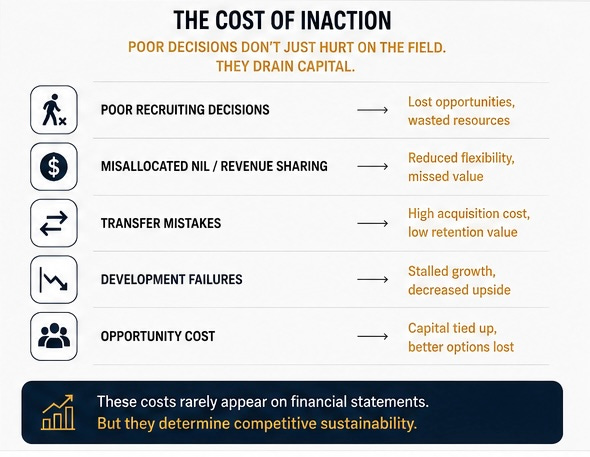
Poor recruiting decisions. Misallocated NIL resources. Overvalued athlete investments. Undervalued retention decisions. Transfer mistakes. Uninsured exposure. Litigation nobody modeled. Opportunity cost.
Those losses rarely appear in annual reports.
They may ultimately cost institutions far more than the buyouts do.
Every expensive roster mistake started as someone else’s “good evaluation.”
Every coverage dispute started as someone’s assumption that the risk was priced.
The market doesn’t suffer from a shortage of opinions.
It suffers from a shortage of independent intelligence.
THE PROBLEM ISN’T COACHES
This is not an argument against coaches. Nor recruiters. Nor collectives, agents, or families.
It is a recognition of organizational reality.
Coaches are hired to win. Recruiters are hired to acquire talent. Collectives are built to support athletes. Agents represent clients. Families advocate for their children.
Every participant carries incentives. Every participant develops blind spots.
That’s not corruption. That’s human nature.
It’s also why every mature financial market eventually created independent underwriting.
Commercial real estate doesn’t ask the seller to determine the property’s value. Private equity doesn’t rely solely on the company’s own projections. Banks don’t ask borrowers to establish their own creditworthiness. And insurance markets — as college sports just spent a decade proving — collapse when no independent standard of value exists.
Independent intelligence exists because incentives influence judgment.
Sports has reached that point.
ATHLETE ASSET UNDERWRITING™
This is where the industry must evolve.
Athlete Asset Underwriting™ is not about predicting who becomes a professional athlete.
It’s about improving the quality of decisions while uncertainty still exists.
It asks different questions.
What is this athlete worth today? How durable is that value? What assumptions support the projection? Where are the greatest risks? How scarce is the position? What is the replacement cost? What is the legal and insurance exposure attached to this asset? How is the athlete developing — not only physically but also mentally, emotionally, and professionally?
Critical thinking. Comprehension. Self-awareness. Adaptability. Decision-making. Leadership. Coachability. Character.
As financial exposure moves earlier, these characteristics become investment variables. Not coaching observations.
Because the athlete is no longer evaluated only on present performance.
The athlete is being evaluated on future value.
INTELLIGENCE MUST BECOME CONTINUOUS
The future of athlete evaluation isn’t one report before the NFL Draft.
It’s continuous intelligence across the athlete lifecycle.
Youth development. Academies. High school. Recruiting. College. NIL. Revenue sharing. Employment classification. Professional opportunities. Long-term career planning.
The athlete becomes one continuously evolving asset.
The intelligence should evolve with it.
L.I.G. SPORTS INTELLIGENCE EXISTS FOR THIS
L.I.G. Sports Intelligence wasn’t built to replace coaches. Or scouts. Or athletic directors, financial advisors, or insurance professionals.
It exists because the economics of sports changed — and the courts and insurance markets are now forcing the issue.
As financial exposure moved earlier, the need for independent athlete intelligence moved earlier too.
Our mission is simple:
To provide independent Athlete Asset Underwriting™ that helps athletes, families, athletic departments, collectives, agencies, insurers, lenders and investors make better decisions before capital, opportunity and careers are committed.
Better intelligence doesn’t eliminate uncertainty.
It improves the quality of the decisions made within it.
FINAL THOUGHT
Every mature market that allocates capital eventually develops independent underwriting.
Commercial real estate did. Private equity did. Insurance did. Credit markets did. Investment banking did.
Sports has reached that moment — and the evidence is no longer hypothetical. It’s in federal court dockets, settlement orders, and a decade of failed insurance products.
The next decade won’t be defined by who recruits the most talent.
It will be defined by who consistently allocates capital more intelligently.
That’s the future of Sports Capital Management.
And Athlete Asset Underwriting™ is the discipline that makes it possible.
Every market that commits capital eventually develops independent underwriting. Sports has reached that moment. The only question left is who builds the standard — and who pays for not having one.
About the Author
Justin King is the Founder of L.I.G. Sports Intelligence, where he is pioneering Athlete Asset Underwriting™, an independent discipline focused on evaluating athlete value, development trajectory, market position, and risk before critical financial, roster, and career decisions are made. His work sits at the intersection of sports intelligence, Sports Capital Management, and strategic advisory for athletes, institutions, and organizations that deploy capital into sports assets.
NIL changed the conversation around athlete value — but underwriting forces us to think about athlete risk, longevity, and asset protection in a totally different way. The athletes who understand this early are the ones who build real wealth, not just income. Justin this is a sharp take that more people in the sport-business space need to read.