



Modern sports are getting very good at pricing upside.
A quarterback has a roster value. A basketball player has NIL value. A professional athlete has contractual value, endorsement value, and future earnings potential. A single college athlete can now represent recruiting capital, direct compensation, third-party NIL value, media value, institutional value, and future professional value — all at the same time.
Everyone can see the upside.
The more interesting question is what happens when the asset doesn't perform as planned. What happens when the athlete gets hurt, development stalls, performance declines, market leverage disappears, or the athlete never reaches the professional market everyone projected?
And most importantly: who owns that downside?
That question is getting harder to answer because the modern athlete doesn't sit on one balance sheet. The athlete sits across several.
One Athlete. Multiple Balance Sheets.
Think about a highly valued college football player. The institution may have committed significant roster capital to acquire and retain him. An insurance carrier may have written coverage against injury or lost future earnings. An agent may have invested substantial time and resources into his development and representation. A lender may be evaluating future income. A collective or commercial partner may hold contractual obligations. The athlete and his family may be making decisions based on projected earnings. And a player association may eventually become responsible for protecting his benefits, rights, health, and long-term economic interests.
One athlete. Different stakeholders. Different exposures.
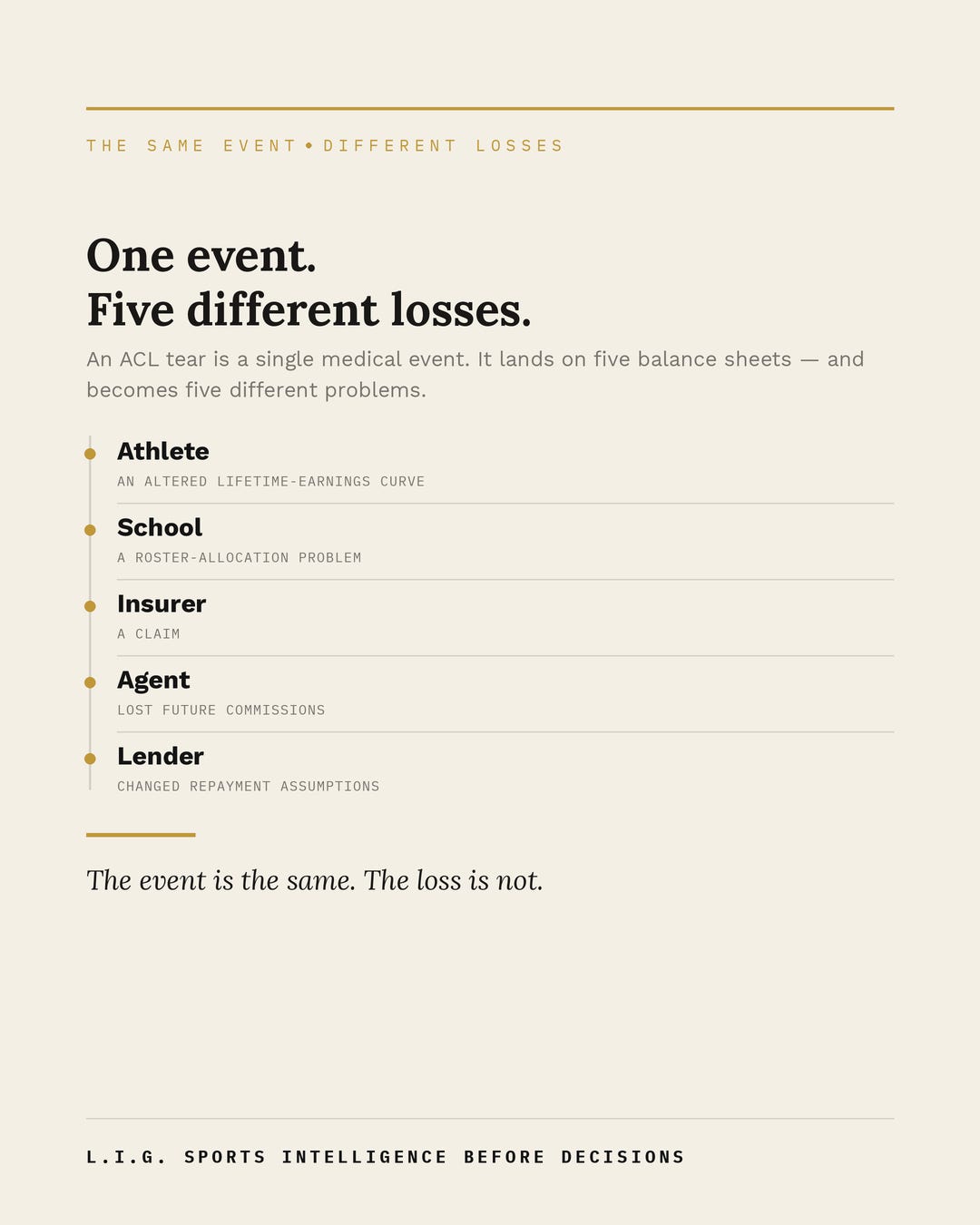
And one negative event hits each stakeholder differently. An ACL injury may be a medical event to the athlete. To the school, it becomes a roster-allocation problem. To the insurer, a claim. To the agent, a decline in expected future commissions. To a lender, a change in repayment assumptions. To the athlete, it may permanently alter lifetime earnings.
The event is the same. The loss is not.
That is why athlete risk has to be understood beyond the traditional idea of insurance. This is an enterprise-risk question.
The professional game already shows how expensive the downside gets when it isn't priced. In 2022, Denver traded a package of players and five draft picks for Russell Wilson, then guaranteed him a roughly $245 million extension before he took a snap. When the performance didn't follow, the guarantee didn't move. Denver released him in 2024 and absorbed about $85 million in dead money — the largest such charge in NFL history at the time. The evaluation was never only "can he still play quarterback?" It was a capital-allocation decision, and the institution owned the entire downside.
Injury Is Only One Form of Athlete Risk
Sports naturally think about athlete risk through injury, and that makes sense — medical risk is visible, measurable, and historically insurable. The infrastructure around it is already substantial. The NCAA requires member schools to certify that athletes have basic accident coverage for athletically related injuries before they may practice or compete, operates a Catastrophic Injury Insurance Program, and, since August 1, 2024, sponsors a Post-Eligibility Insurance Program that provides excess medical coverage for qualifying athletically related injuries for up to two years after participation ends.
Professional sports go further. The NFLPA’s benefits structure spans health insurance, disability and neurocognitive benefits, survivor and life insurance, retirement and pension plans, savings and annuity programs, and health reimbursement accounts — protections that change based on where a player sits in the career lifecycle.
Those systems matter. But medical exposure is only one dimension of athlete risk. Consider the broader profile:
Availability risk. Will the athlete consistently be available to perform?
Performance risk. Will projected production actually materialize?
Development risk. Does the athlete have the physical, technical, and psychological infrastructure to reach the expected ceiling?
Transfer or mobility risk. Can the organization reasonably expect to retain the athlete long enough to realize its investment?
Contract risk. What obligations remain if circumstances change?
Market-value risk. What happens if demand for the athlete deteriorates?
Reputation risk. Could behavior materially alter commercial or institutional value?
Replacement risk. If the athlete becomes unavailable, how scarce and expensive is the replacement?
Career-interruption risk. What happens when a projected career path stops earlier than expected?
Each of these can create financial consequences without generating a traditional medical claim. That distinction matters, because an athlete can be medically healthy and still become a deteriorating financial asset.
College sports are already producing these losses. Quarterback Jaden Rashada flipped his commitment to Florida in 2022 on the strength of a reported four-year, roughly $13.85 million NIL package tied to the school's collective — after turning down a reported $9.5 million offer elsewhere. The deal collapsed before he ever played a down; he received only a fraction of what was promised, requested his release, and later sued. The parties settled in 2026. No injury. No medical claim. An athlete's committed value simply evaporated — and everyone who had built a decision around that number was exposed.
The Information Problem
The modern athlete market has another problem: the information reaching decision-makers is rarely neutral.
Coaches recruit the athlete. Agents recruit the athlete. Collectives, schools, and brands recruit the athlete. Advisors want to maintain the relationship. Families advocate for the athlete. Even internal personnel departments can become invested in proving their original evaluation correct. None of that makes those parties dishonest — it simply means incentives shape information.
This happens everywhere capital is deployed, which is precisely why decision-makers need intelligence independent of the transaction. We don’t have a side. We have the data.
The issue is sharper in sports because so much athlete evaluation remains subjective. Film evaluation can tell you whether an athlete possesses certain traits. Medical evaluation can identify physical history and clinical risk. Background checks can surface behavioral or legal concerns. Analytics can model production. But those pieces frequently sit in separate rooms. What is usually missing is a structured view that connects the athlete’s competitive reality to the financial exposure around them. That is the intelligence gap.
Two Athletes Can Look Identical on an Actuarial Table
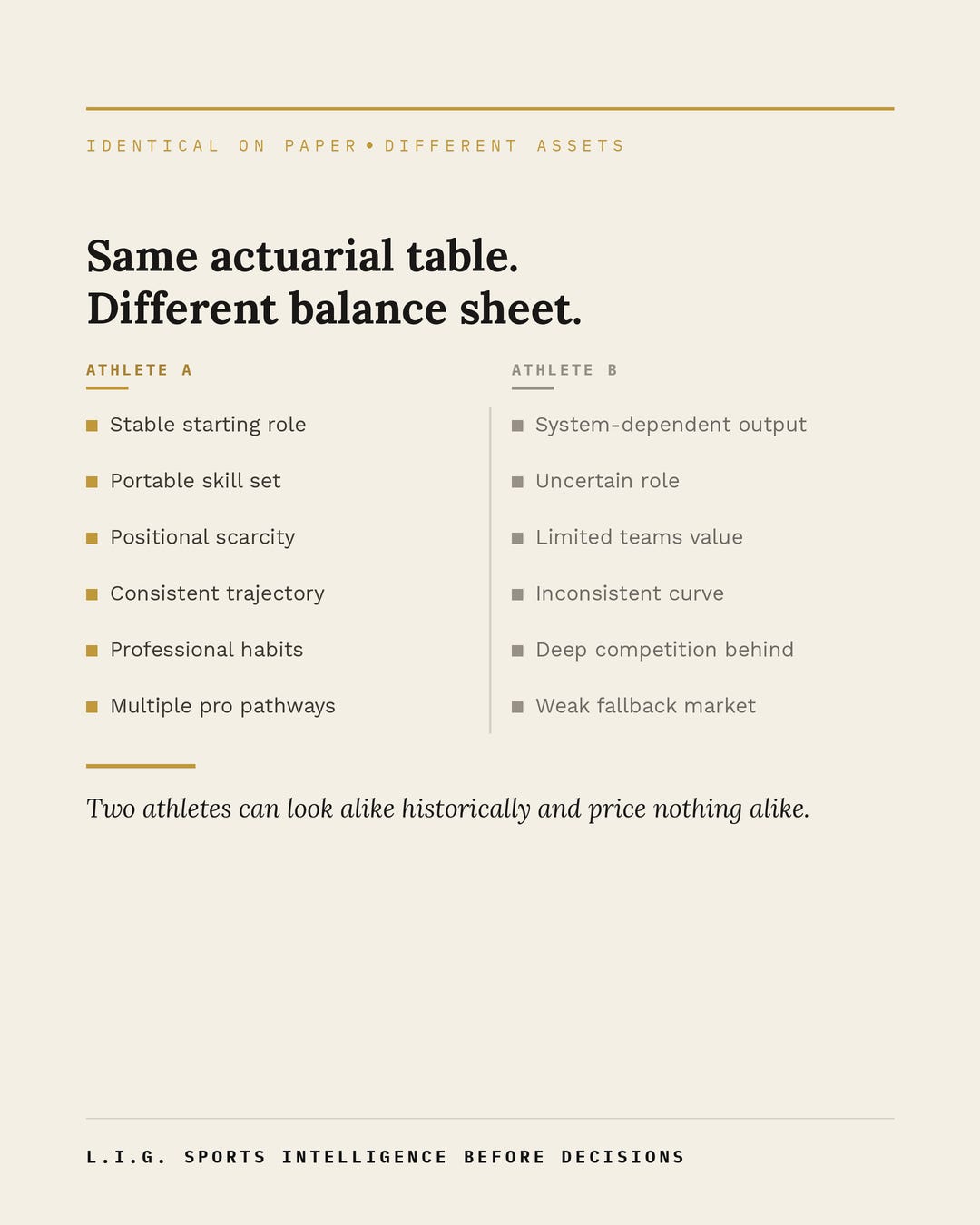
Consider two 21-year-old wide receivers: same height, similar weight, similar medical history, same conference, comparable production. An actuarial model may reasonably place them inside similar historical populations. From an athletic-risk standpoint, the two assets could differ dramatically.
Athlete A may have a stable starting role, a highly portable skill set, strong positional scarcity, a consistent developmental trajectory, low replacement availability, professional habits, and multiple potential professional pathways.
Athlete B may have production heavily dependent on one offensive system, uncertain role stability, limited special-teams value, an inconsistent developmental curve, significant competition behind him, high transfer probability, and a weak market if the current opportunity disappears.
Those athletes may look similar historically. They are not necessarily similar economically. This doesn’t mean athletic intelligence should replace actuarial science — or medical evaluation. The opportunity is integration.
A Three-Layer View of Athlete Risk
A more complete athlete-risk architecture requires at least three separate intelligence layers.
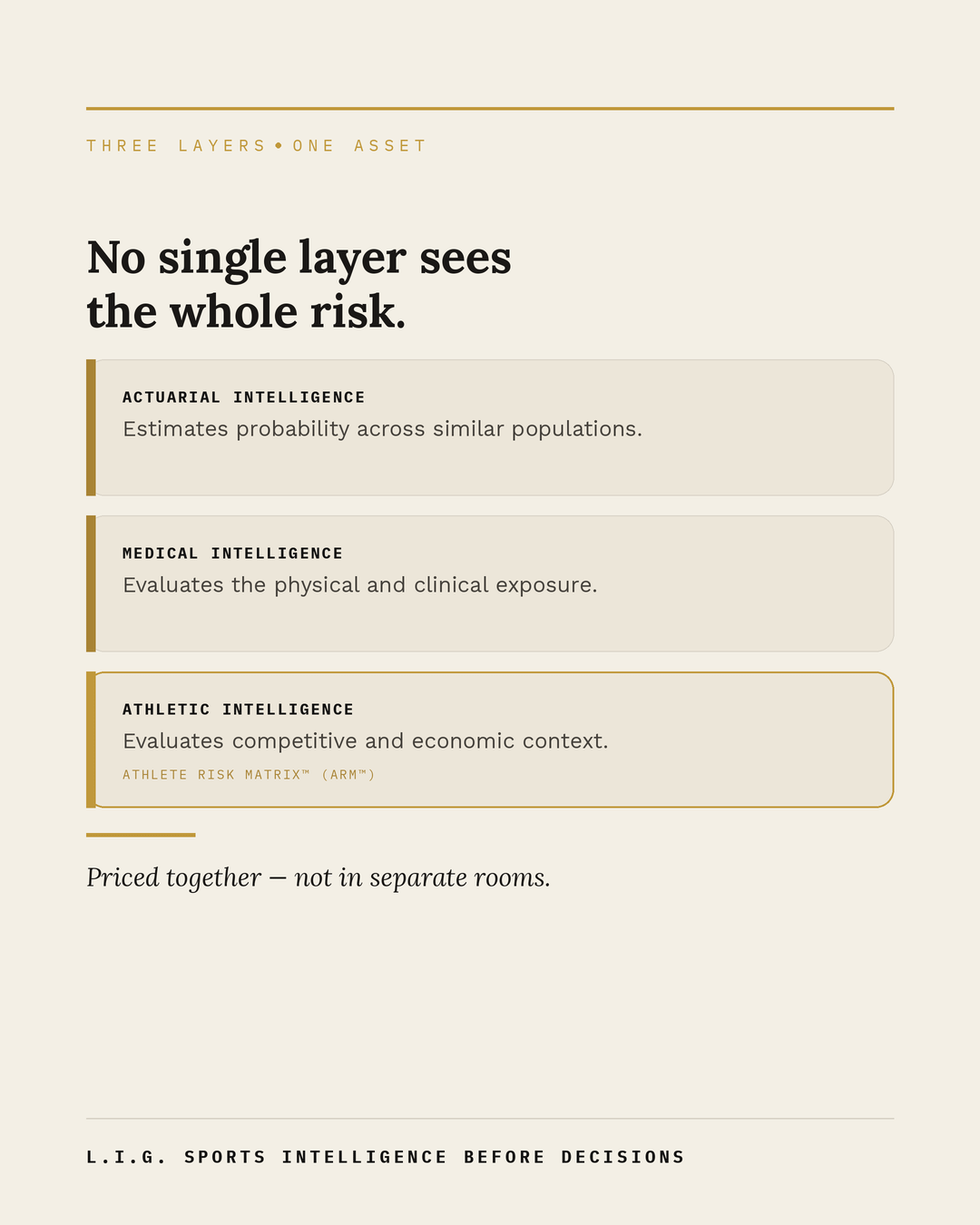
1. Actuarial intelligence — what historically happens to similar populations? Age, position, sport, injury frequency and severity, historical claims, career duration, probability. Without that layer, risk becomes anecdotal. But population probability alone does not tell you everything about an individual asset.
2. Medical intelligence — what does this athlete’s physical and clinical profile indicate? Medical history, previous surgeries, imaging, biomechanics, recovery history, current conditions, clinical prognosis. This layer belongs firmly in the hands of qualified medical professionals.
3. Athletic intelligence — what is happening around the asset? Role, usage, trajectory, positional scarcity, competitive environment, development curve, replacement economics, market demand, roster position, scheme dependency, career pathway, professional readiness, organizational fit. Athletic intelligence does not diagnose an ACL. It explains what losing that ACL — or losing that athlete — means economically. This is the layer L.I.G. builds through the Athlete Risk Matrix™ (ARM™): an underwriting risk grade on the individual athlete. Aggregated across a roster and combined with institutional factors, those grades roll up into an Institutional Risk Aggregate™ (IRA™) — a program-level exposure profile for the athletic department, lender, or insurer carrying the risk.
Actuarial intelligence estimates probability. Medical intelligence evaluates physical exposure. Athletic intelligence evaluates competitive and economic context. The goal is not to decide which layer is superior — it is to stop pretending one layer provides the entire picture.
Who Should Actually Own the Downside?
Once you understand the exposure, the next question is allocation. Who should retain the risk? Who should transfer it? Who should price it into the transaction? Who should contract around it?
Those decisions vary by stakeholder. An institution may decide certain athlete exposure should stay on its balance sheet because the competitive upside justifies it. An insurer may decide certain exposure can be transferred — but only at an appropriate premium. A lender may alter terms based on the durability of projected income. An agent may decide how much capital to invest in a client. A player association may negotiate protections around health, disability, income interruption, benefits, and post-career security.
The NFLPA shows how sophisticated player protection becomes when the economic system matures: its benefits ecosystem spans insurance, disability, retirement, savings, post-career health resources, and career-transition support rather than treating athlete protection as a single product. College sports are earlier in that evolution, but moving in the same direction. Once the athlete becomes a compensated economic participant, somebody has to determine what happens when the expected economic value does not materialize.
Protecting the Asset Before It Breaks
Another side of underwriting often gets overlooked. Risk intelligence should not exist solely to decide whether to insure, sign, recruit, or finance an athlete. It should also identify where the asset can be strengthened.
If developmental instability shows up early, address it. If the support infrastructure is weak, strengthen it. If financial decisions are creating unnecessary exposure, improve education. If professional habits threaten reliability, intervene. If the athlete’s market value depends too heavily on one narrow competitive outcome, build additional leverage.
This is where athlete protection and Athlete Asset Underwriting™ intersect. The objective isn’t to label athletes as risky. The objective is to understand the risk well enough to manage it.
From Player Benefits to Athlete Enterprise Risk
The larger opportunity is that sports may eventually stop treating these functions as separate conversations. Insurance, player benefits, personnel, risk management, financial education, career development, roster construction, contract design, mental performance, transition planning — different disciplines, all interacting with the same underlying asset: the athlete.
For the athlete, that means protecting human and economic value across the lifecycle. For the institution, understanding the financial exposure attached to roster decisions. For the insurer, understanding the context around the risk being transferred. For a player association, understanding where member protection needs to evolve as athlete economics evolve. For capital providers, understanding what actually sits underneath expected future value.
That is why the future of athlete risk management is broader than writing better insurance policies. It requires better information architecture.
Sports Has Priced the Upside. Now Price the Downside.
Sports will never be risk-free, and it shouldn't be. The organizations that win are often the ones willing to accept risks others won’t. Elite athletes are frequently asymmetric bets: enormous upside, unique scarcity, outcomes that cannot be perfectly forecast. The goal is not to eliminate those bets. It’s to understand them — before the money moves, before the contract is signed, before the athlete is acquired, before the policy is written, before the loss occurs.
The modern sports economy can already assign increasingly precise numbers to athlete upside: compensation, NIL, contracts, future earnings, roster value, commercial value. The next evolution is the other side of the ledger. What can go wrong? What does that loss actually cost? Who is exposed? Who should retain the risk, and who should transfer it? And what intelligence should have existed before the decision was made?
Because every athlete asset carries upside. Every athlete asset carries downside. And eventually, somebody owns both.
At L.I.G. Sports Intelligence, our role is not to replace the insurer, actuary, physician, personnel executive, or player advocate. It is to provide an independent athletic-intelligence layer — through Athlete Asset Underwriting™, ARM™, and IRA™ — that helps those stakeholders understand the asset in context, before capital is committed.
If you’re an athletic department, collective, insurer, lender, or capital partner carrying athlete exposure this year, that’s exactly the read L.I.G. provides. Subscribe to The Sports Capital Review to follow the work, or reach out for an independent look before the next decision is priced.
Intelligence Before Decisions.
— Justin King, Founder, L.I.G. Sports Intelligence · The Sports Capital Review
Sources
NCAA Post-Eligibility Insurance Program — http://www.ncaa.org/student-athletes/insurance-and-medical-coverage/post-eligibility-insurance-program/
NCAA medical coverage / insurance overview — https://www.ncaa.org/sports/2021/2/10/medical-coverage.aspx
NFLPA Benefits and Services — https://nflpa.com/active-players/benefits-and-services
NFL.com, Overview of NFL Player Benefits — https://www.nfl.com/playerhealthandsafety/resources/for-players-and-former-players/overview-of-nfl-player-benefits
Russell Wilson / Broncos record $85M dead money (ESPN) — https://www.espn.com/nfl/story/_/id/46616201/denver-broncos-build-contender-russell-wilson-trade-release-85-million-dead-money
Jaden Rashada NIL lawsuit settlement (ESPN) — https://www.espn.com/college-football/story/_/id/47960080/jaden-rashada-former-gators-football-coach-billy-napier-florida-booster-settle-lawsuit-failed-nil-deal