


Rivals announced today that high school athletes can pay to be evaluated by its scouts. Awful Announcing first reported the announcement, and Yahoo Sports, The Spun, and others picked it up through the afternoon. The listed price is $499, currently discounted twenty percent to $399. The purchase includes a scouting report, an evaluation grade, and ranking consideration. A separate tier, $60 discounted to $30, creates and verifies an athlete’s profile on the platform.
Rivals has been direct about what the money does and does not buy. Its published position is that ratings, rankings, and star designations are earned rather than purchased, and that payment guarantees no particular evaluation outcome. Founder Shannon Terry framed the program as a capacity problem rather than a revenue one: roughly 1.04 million boys played high school football last season, while Rivals has typically carried about 6,600 star-rated prospects at any given time. That is a fraction of one percent. The overwhelming majority of high school athletes have never had a national evaluator watch their film, and the company argues that the traditional model was never built to reach them.
That argument has merit. The capacity gap is real, and a market that only evaluates the top half of one percent leaves a great deal of talent unexamined.
But the structure of the solution deserves more attention than it is getting.
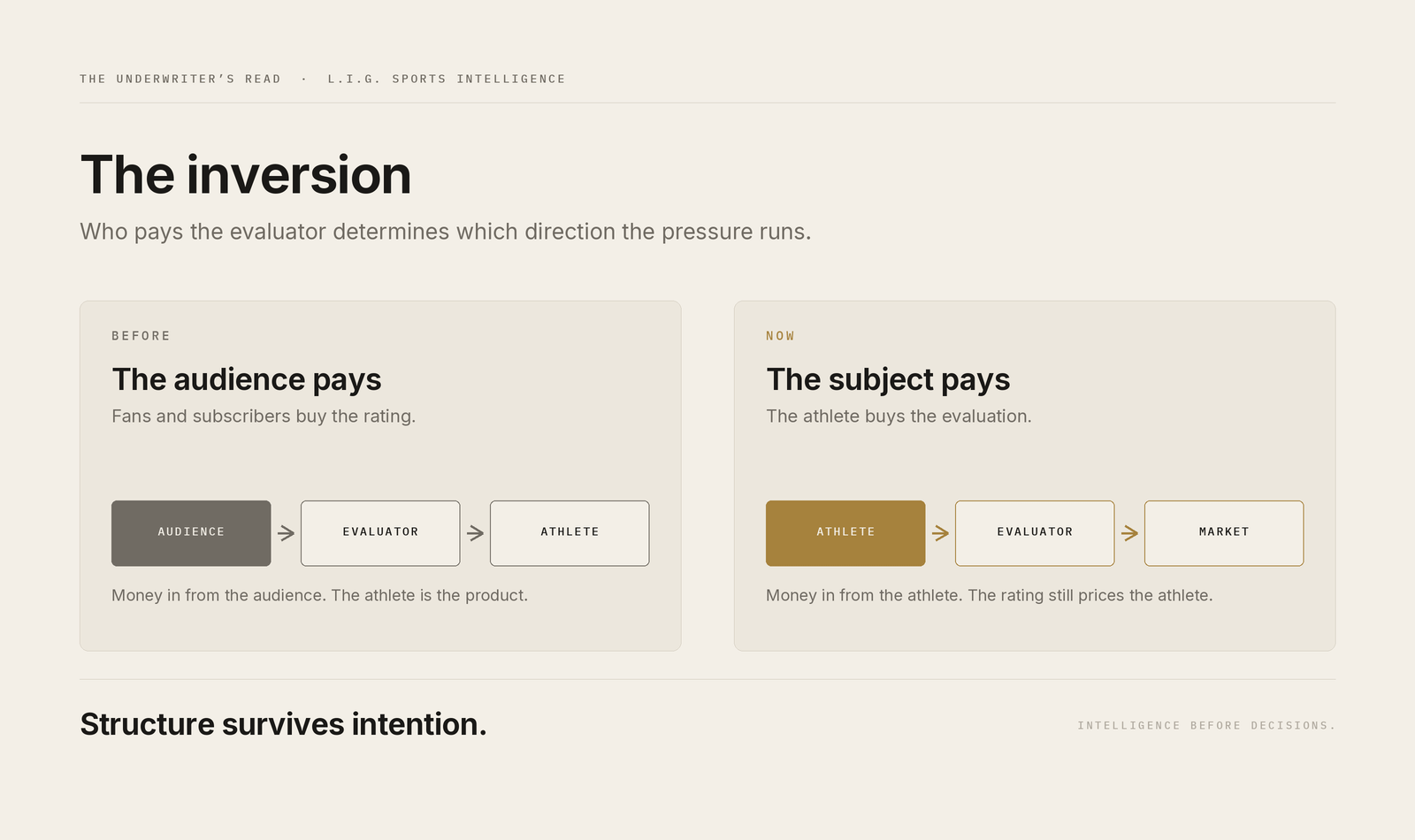
Before: the audience funds the analysis and the athlete is the product. Now: the athlete funds the analysis and the rating still prices the athlete.
The issuer-pays problem
Credit rating agencies did not always bill the companies they rated. For most of their history, investors paid for ratings—the people using the information bore the cost. In the early 1970s, the model inverted. The issuers began paying to be rated.
The logic at the time was defensible and, in its own terms, correct. Photocopying had made investor-pays subscriptions leaky. Coverage needed to expand. Issuers wanted access to capital markets and were willing to fund the analysis that made access possible. More issuers could be rated, more information reached the market, and the agencies could afford deeper research.
Nobody set out to corrupt anything. The agencies built firewalls, published methodologies, and maintained that ratings were determined by analysis rather than by who paid. For decades that was largely true.
Then structured finance arrived, volumes grew, the issuers became repeat customers with real leverage, and the conflict that had been theoretical became material. When the crisis came in 2008, the issuer-pays model was among the most examined features of the system—not because individual analysts were dishonest, but because the incentive structure had pointed one direction for thirty-five years and nobody had priced that in.
The lesson is not that issuer-pays is fraud. The lesson is that structure survives intention. Good people inside a conflicted structure eventually produce conflicted outcomes, not because they decide to, but because the pressure only ever runs one way.
What does this have to do with a $399 scouting report?
A recruiting service produces a rating. That rating affects what a program offers, what a collective will fund, what a family believes is possible, and increasingly what money is attached to an athlete’s name. In a market where NIL, revenue share, and portal movement are denominated in real dollars, a public evaluation is not commentary. It is closer to a price signal.
Until today, the people paying for those signals were fans and, indirectly, the programs. Starting today, some portion of them will be paid for by the athletes being signaled about.
Rivals says the payment buys access to the evaluation process and nothing more. Take that at face value — there is no reason not to. The question that remains is structural, and it is the same question the ratings agencies faced: over five years and a hundred thousand transactions, which direction does the pressure run?
A paying customer who receives a disappointing grade does not renew. A paying customer who receives an encouraging one tells other families. No individual has to do anything improper for that gradient to shape an institution. It is simply the shape of the incentive.
What families are actually buying
This is where the market needs more precision than it currently has, because four different products are being sold under one word.
Evaluation is an opinion about ability. It tells you how one observer sees the athlete on the day they looked.
Exposure is placement in a system coaches already watch. It has real value, and it is largely what a recruiting platform sells.
Valuation is what the athlete is worth in a market—different from how good they are, and that distinction is the whole game once money is involved.
Strategy is what to do next. Which gap to close first, which offers to take seriously, where leverage actually sits, and what to walk away from.
A $399 scouting report is a genuine product in the first two categories. It is not designed to answer the second two, and it would be unfair to criticize it for failing to do something it never claimed to do. The risk is on the buyer’s side: a family that purchases an evaluation believing they bought a strategy will make the next three decisions with a document never built to inform them.
And the evaluation is not where the money is at stake. The exposure is the commitment made a year early because a grade read encouraging, the first NIL offer accepted without any independent sense of what that position is worth, the twelve months of development aimed at a weakness that was never the binding constraint. Those decisions are denominated in scholarship dollars, contract terms, and years an athlete does not get back. By the time any of them is visibly wrong, none of them is recoverable — which is why the order matters: the evaluation costs a few hundred dollars, and the decision built on top of it costs whatever the athlete was actually worth.
The four questions
Before paying for any type of evaluation — ours, comprehensive Blueprint Advisory included — a family should be able to answer these:
Who pays the evaluator, and what do they want? Not as an accusation. As a fact you should know before you weigh the output.
What does this document decide? If the answer is “nothing specific,” it is information, not intelligence.
What would make this evaluation wrong? A credible assessment states its own limits and the conditions that should trigger a reassessment. One that reads as pure upside is marketing.
What happens after I read it? An evaluation that ends with a grade hands the hardest part of the job back to the family.
What we think this means
Read past the discourse, and today’s announcement confirms something we have been arguing for six years: the athlete market is formalizing from the bottom up, and the evaluation layer is being priced because it has become economically load-bearing.
That is not a scandal. It is a market maturing, and maturing markets eventually develop independent evaluation as a discipline separate from the transaction—because participants learn the hard way what it costs when the two are combined. Equity research separated from underwriting. Property appraisal separated from lending. Auditing separated from consulting. Each separation followed a period in which everyone involved insisted the combination was working fine.
Sports is at the beginning of that arc, not the end.
The money moved. The intelligence didn’t.
Recruiting identifies talent. Underwriting evaluates investment. Those have always been two different questions. What changed today is that the market started charging families for the first one, which makes it considerably more urgent that somebody is asking the second.
L.I.G. Sports Intelligence is an independent sports capital and executive advisory firm.
Intelligence Before Decisions.
The line worth sitting with: evaluation is an opinion, valuation is what you're actually worth, and only one of those decides your leverage. Families keep paying $399 for the first one and building six-figure decisions on top of it like it answered the second. That's the real gap here, not whether the rating can be bought. If you're an athlete or a family in this market, the money belongs on strategy - the part that turns a grade into an actual number - not on the grade itself.