


For most of modern college sports, talent evaluation reigned supreme. How fast is he? How explosive is she? Can he cover? Can she score? Can the quarterback make every throw? What does the film say?
Those questions still matter. A lot.
Let’s not overcorrect simply because the economics have changed: talent equals tolerance. Elite talent creates leverage, extends developmental timelines, and causes organizations to accept risks they would never accept from an average player. That has always been true, and it will remain true.
But tolerance is no longer free.
The House settlement introduced direct athlete revenue sharing and formal roster limits. Football programs operating under the settlement now work within a 105-player roster limit, and each participating school can share up to $20.5 million directly with athletes in 2025–26 — a figure set to rise every year of the deal. The economic flexibility that once let programs stockpile, develop, and miss on talent without directly pricing every roster spot has tightened considerably.
That changes the question.
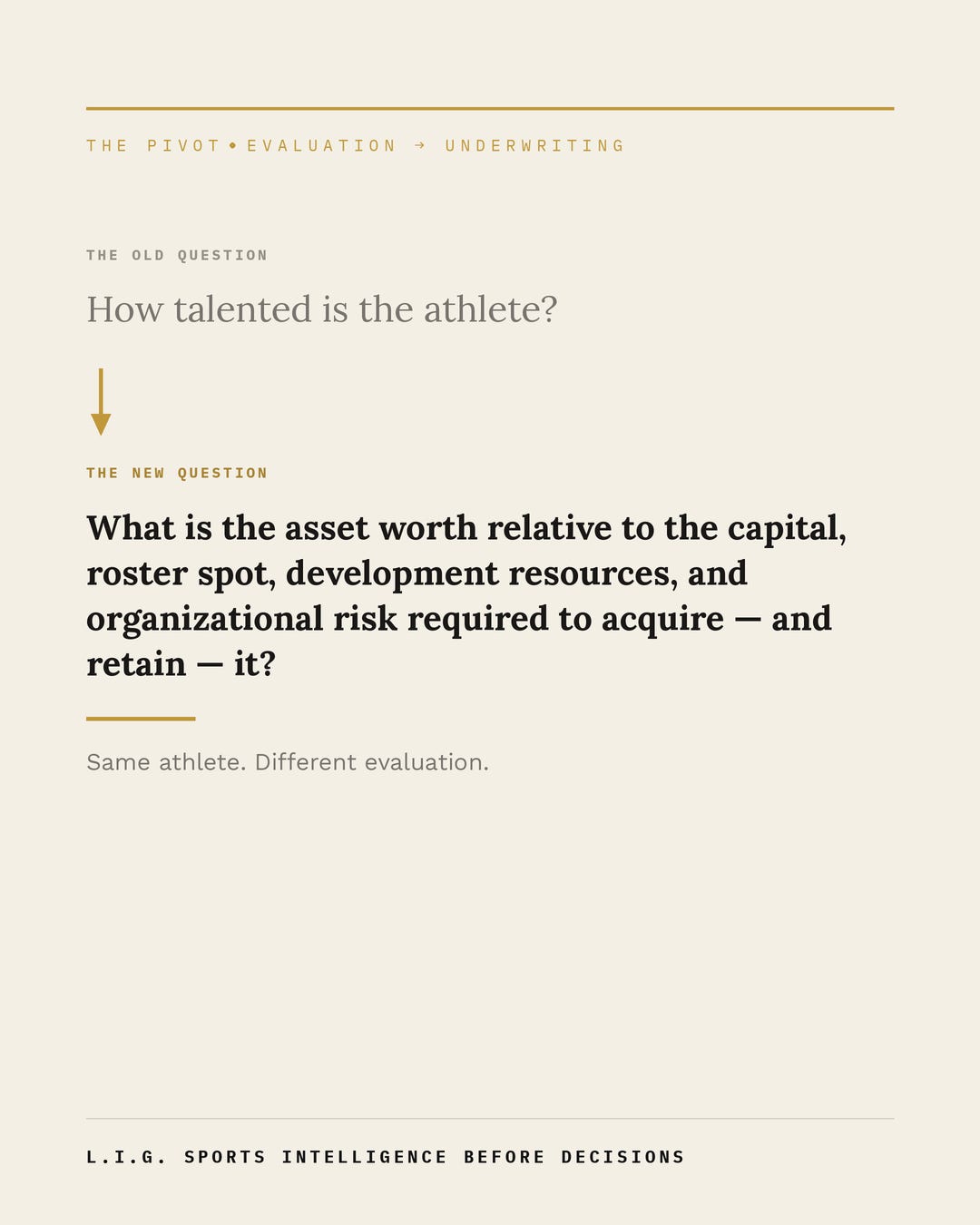
It is no longer simply: How talented is the athlete?
It becomes: What is the asset worth relative to the capital, roster position, development resources, and organizational risk required to acquire and retain it?
Those are not the same evaluation. And that distinction may become one of the most important operating concepts in modern sports.
Talent Evaluates Ability. Asset Value Evaluates the Investment.
Traditional player evaluation is largely built to answer a performance question: Can this athlete play, how well, at what level, and against what competition? What are the physical traits, and where is the developmental ceiling?
Good evaluation can tell an organization a tremendous amount about the athlete. But it cannot answer the entire investment question.
Once meaningful capital is attached to the decision, the organization also needs to understand scarcity, developmental trajectory, durability, replacement cost, positional value, roster fit, market demand, professional habits, brand readiness, transfer or retention risk, and downside exposure.
An athlete can receive an A-grade talent evaluation and still represent a B-grade investment at a certain price. Likewise, an athlete who is not the most naturally gifted player available can carry tremendous asset value, because the athlete is scarce, ascending, durable, dependable, difficult to replace, and perfectly aligned with what the organization needs.
That isn’t devaluing talent. That’s pricing it.
Production Is Backward-Looking. Asset Value Is Forward-Looking.
Statistics tell us what happened. Underwriting has to estimate what happens next.
An athlete with 1,200 receiving yards has produced 1,200 receiving yards. That’s evidence. But the organization committing future capital has a different set of questions. Was the production scheme-dependent? Is the athlete ascending or near his ceiling? How portable is the production to another system? What does the injury history suggest? How difficult would the player be to replace? Is the market paying a premium because of legitimate scarcity, or because multiple programs became desperate at the same time?
Even the cost of development matters. A player who requires two years of technical development to reach expected performance carries a different economic profile from an athlete expected to produce immediately, even if their eventual ceilings are similar.
This is why current production and projected asset value cannot be treated interchangeably. One measures output. The other prices probability.
Scarcity Changes Everything
Talent doesn’t exist in a vacuum. Markets price alternatives.
An above-average quarterback in a market with very few starting-caliber quarterbacks may command greater economic leverage than an objectively better athlete at a position with abundant replacement options. That’s not a contradiction. That’s scarcity.
The same principle exists everywhere capital is allocated. What does the asset provide? How badly is it needed? How many alternatives exist? What will those alternatives cost? What happens if we lose this one?
College sports is encountering this in real time. The litigation surrounding the NCAA’s new framework — which gives athletes five years to play five seasons — and the late-August 2026 decisions by the Big Ten (football) and SEC (football and basketball) to bar athletes with professional experience from returning to college competition show how quickly policy can alter the available supply of players. Change the supply, and you immediately change scarcity, leverage, and replacement economics.
That’s why replacement cost may ultimately become as important as production when evaluating athlete value. If I lose this athlete tomorrow, what would it cost me — in capital, development time, roster flexibility, and competitive performance — to replace him? That’s an asset question.
Durability Is Bigger Than Injury History
Sports traditionally defines durability physically: Can the athlete stay healthy? That’s part of it. But an asset can be physically durable and economically fragile.
Modern durability also includes competitive consistency, professional habits, decision-making, adaptability, retention probability, mental resilience, and the quality of the support and advisory infrastructure surrounding the athlete. Can the organization reasonably forecast what it is buying? That distinction matters more as compensation arrives earlier.
A highly talented athlete who becomes unavailable, disengages when adversity hits, constantly requires organizational intervention, cannot adjust to increased expectations, or leaves whenever market conditions change creates volatility around the investment. That doesn’t automatically make the athlete a bad investment — the upside may justify every bit of that risk. But somebody needs to price the risk before committing capital.
That’s underwriting.
Fragile Value vs. Durable Value
This is where the industry needs a more sophisticated vocabulary. Two athletes can carry similar headline valuations while having completely different underlying structures.
One athlete’s value may depend almost entirely on elite physical traits. If production dips, the scheme changes, or availability becomes an issue, the value deteriorates rapidly. That’s fragile value.
Another athlete may combine high-level talent with positional scarcity, consistent production, developmental trajectory, adaptability, professional reliability, and multiple ways of creating organizational value. That’s durable value.
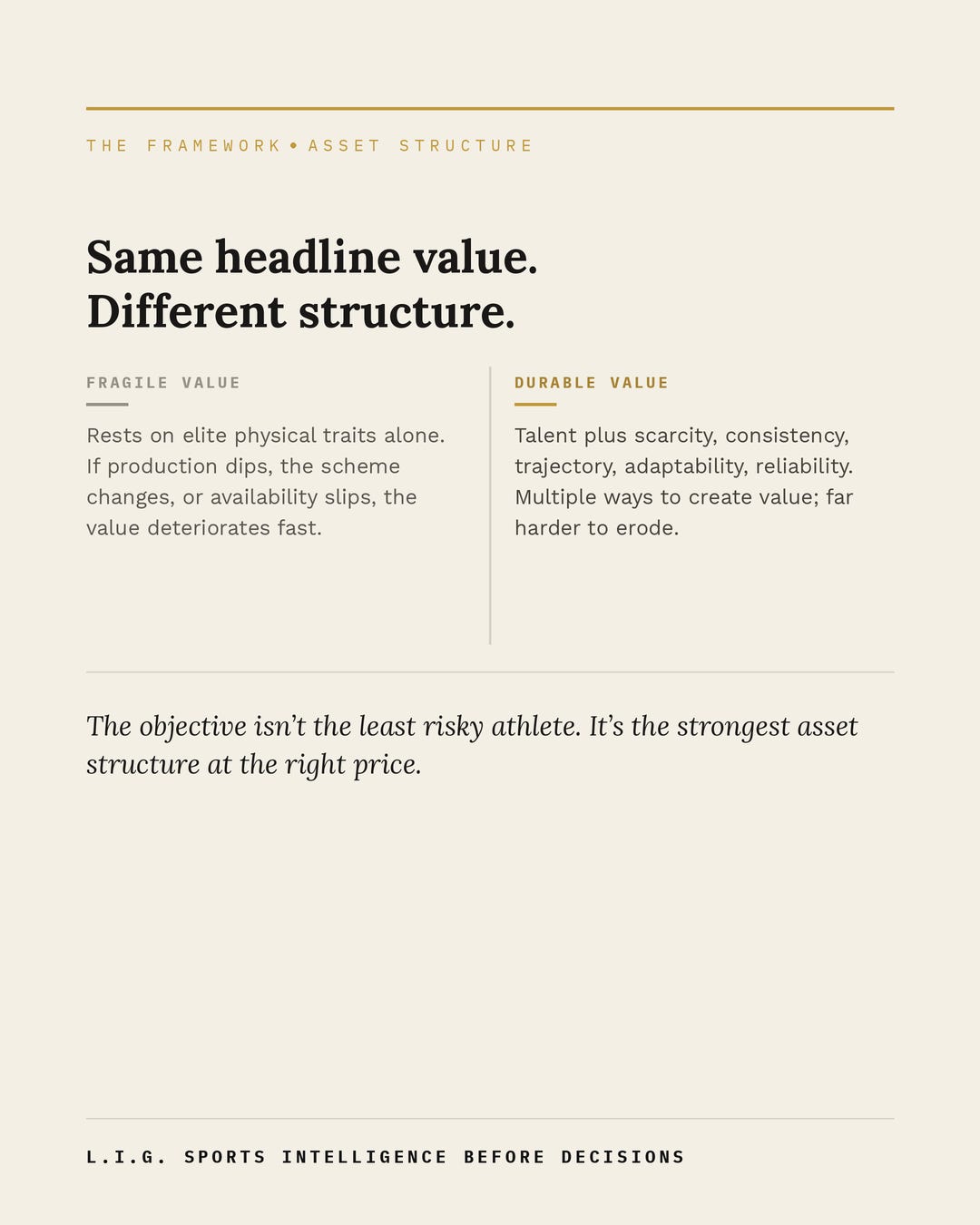
The objective isn’t to eliminate risk. You can’t — and building a roster exclusively around “safe” athletes is a good way to become safely average. Winning still requires taking risk. The objective is identifying where the upside justifies the exposure.
The best organizations shouldn’t be looking for the least risky athletes. They should be trying to acquire the highest level of talent with the strongest underlying asset structure at an appropriate price. That is a completely different exercise.
Talent Still Buys Tolerance
Football provides perhaps the clearest example. Because the sport depends so much on rare physical traits: size, length, speed, explosiveness, and positional athleticism, exceptional talent can cover deficiencies longer than it does in many other industries. Organizations will develop it. Coaches will tolerate it. Programs will bet on it. Professional teams will investigate it.
But eventually every athlete reaches another underwriting event.
A recent public dispute involving former Pitt receiver Raphael “Poppi” Williams Jr. illustrates the tension. Williams publicly challenged what he said was a negative pre-draft character evaluation circulated about him and argued that it affected his professional opportunities. Reporting around the dispute also noted that Pitt coach Pat Narduzzi had publicly praised Williams’ character around the same time he went undrafted. The accuracy and context of the disputed evaluation remain separate questions. What matters for this discussion is what the episode exposes: professional markets evaluate significantly more than statistics and film when deciding whether to invest in an athlete.
Production gets you evaluated. Total assets determine how organizations eventually price the opportunity.
When Asset Risk Becomes Enterprise Risk
Professional sports provides the extreme version of the same lesson. Look at Cleveland.
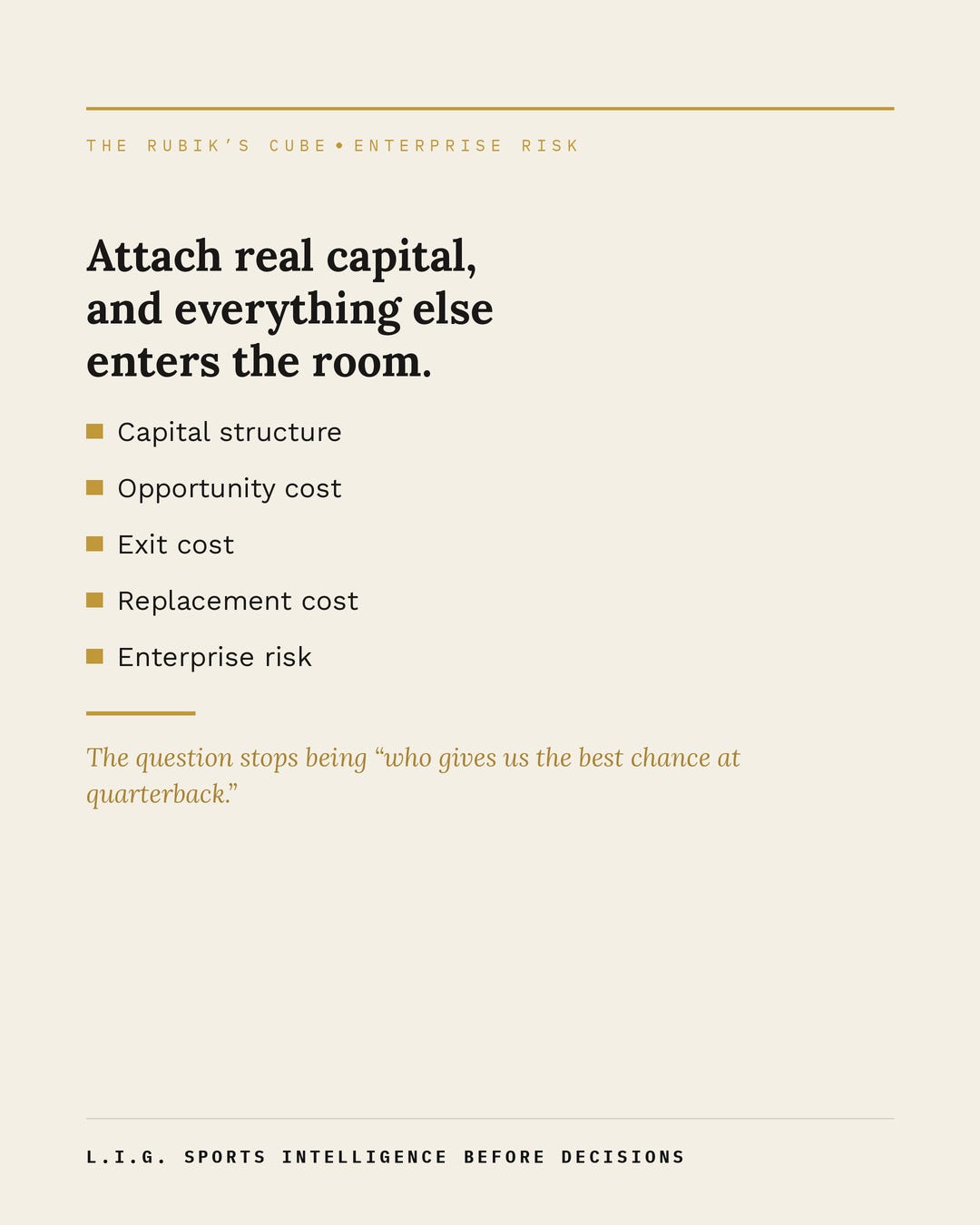
The Deshaun Watson contract wasn’t simply a quarterback evaluation. It was an organizational capital-allocation decision. Cleveland acquired Watson in 2022 on a five-year, $230 million fully guaranteed contract — and sent three first-round picks to do it. When the on-field results didn’t follow, the guarantee didn’t move. As of August 2026, the structure still carries more than $130 million in dead-cap exposure, and the mechanics of moving on remain punishing. At that point, the evaluation is no longer merely: Who gives us the best chance to play quarterback?
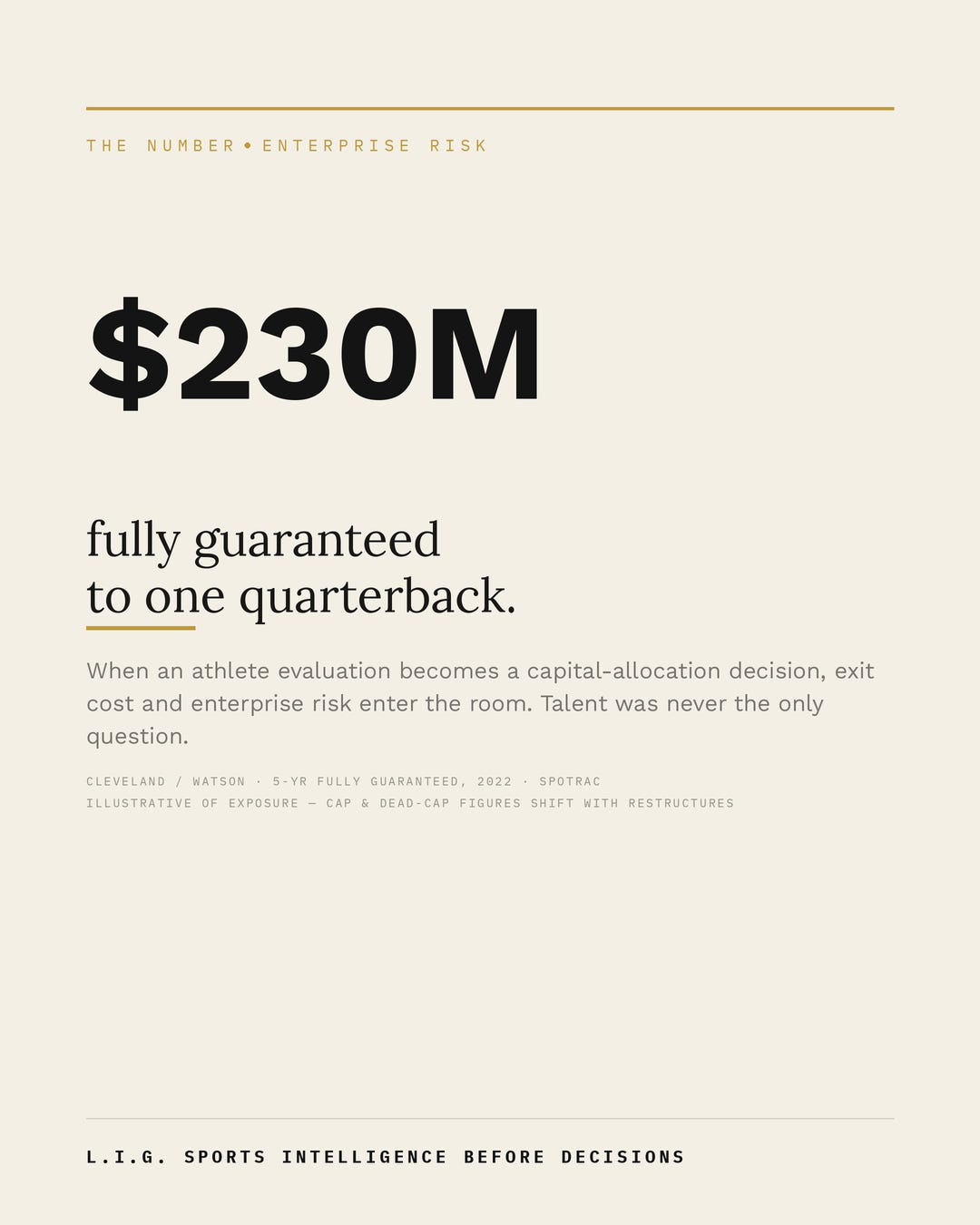
Capital structure enters the room. Opportunity cost enters the room. Exit cost enters the room. Replacement cost enters the room. Enterprise risk enters the room.
That’s the Rubik’s Cube.
College sports is moving toward its own version of that complexity: without decades of salary-cap infrastructure, collective bargaining history, contract standards, and mature valuation systems behind it. Which means the need for better intelligence comes before, not after, the mistakes become expensive.
The Total Athlete Is the Asset
This matters for institutions. It also matters for families.
A young athlete’s goal cannot simply be to become talented enough to get recruited. The goal should be to build an asset capable of surviving and creating leverage inside an increasingly professional sports economy.
That starts with talent. It always will. But the infrastructure around that talent matters more now: physical development, technical development, competitive performance, academics, professional habits, decision-making, brand readiness, financial literacy, mental resilience, and an understanding of how the business actually works.
Families that understand this early will prepare athletes differently. Programs that understand it will recruit and retain differently. Agents will invest differently. Insurers and lenders will price exposure differently. Athletic departments will allocate capital differently.
Because the most talented athlete is not always the most valuable athlete. And the most valuable athlete is not necessarily the safest asset. The objective is not choosing between talent and stability — it is finding elite talent whose underlying asset structure gives the organization the highest probability of realizing the investment.
That is the distinction.
From Evaluation to Underwriting
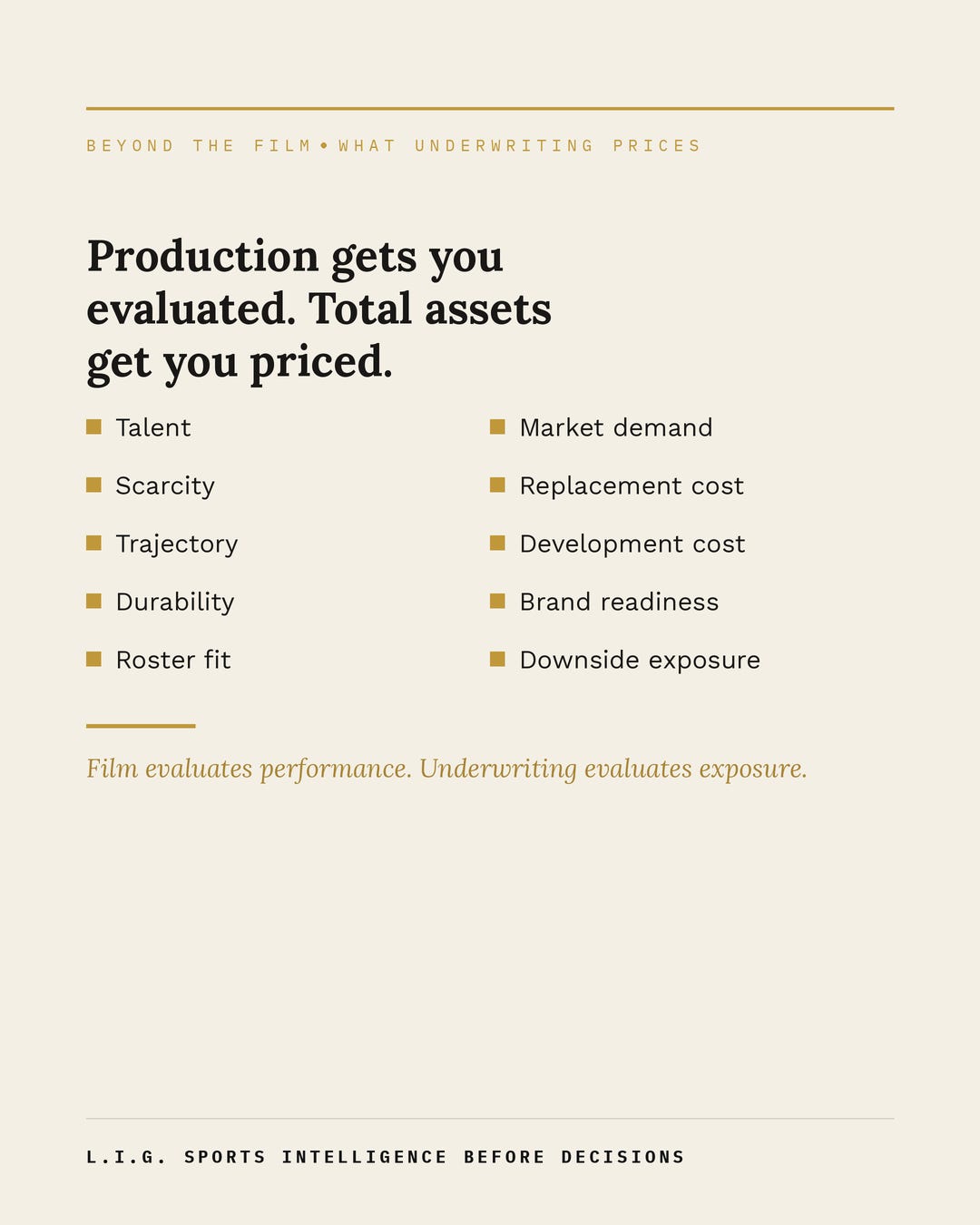
The next phase of sports will require organizations to move beyond simply identifying players. They will need to understand what they are actually buying: talent, scarcity, trajectory, durability, fit, market demand, replacement cost, development cost, brand readiness, and downside exposure.
Film remains essential. Statistics remain essential. Scouting remains essential. But none of them answers the capital question on its own.
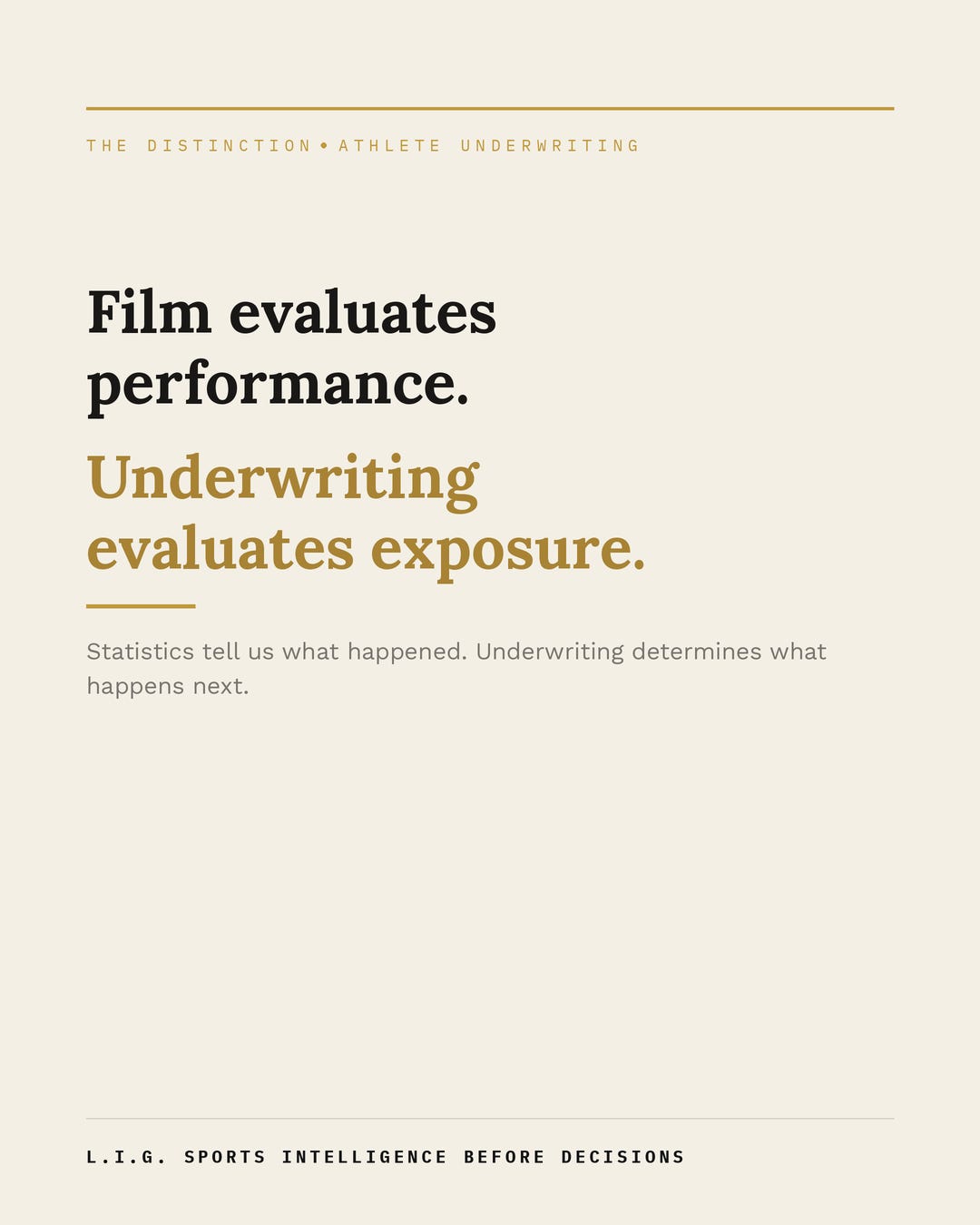
Film evaluates performance. Underwriting evaluates exposure. Modern sports organizations increasingly need both.
At L.I.G. Sports Intelligence, our work sits at that intersection; helping institutions, capital partners, athletes, and families understand the complete asset before consequential decisions are made. For organizations, that means stronger Athlete Asset Underwriting™, roster capital allocation, and enterprise-risk intelligence. For athletes and families, it means developing more than a recruit — deliberately building an athlete capable of retaining value as the level of competition, compensation, and scrutiny increases.
Because capital has already entered the game. The evaluation model now has to catch up.
The Sports Capital Review publishes this analysis bi-weekly. Subscribe to follow the work — and if your program, fund, or family is facing a decision where the price of being wrong is rising, that's precisely the moment for an independent read.
Justin King
Founder, L.I.G. Sports Intelligence
The Sports Capital Review — Intelligence before capital is committed.
Sources
House settlement — revenue sharing, roster limits, $20.5M cap
ESPN, “Judge grants final approval to House v. NCAA settlement” — https://www.espn.com/college-sports/story/_/id/45467505/judge-grants-final-approval-house-v-ncaa-settlement
Sportico, “Every Division I School’s Revenue-Sharing Decision for 2025-26” ($20.5M cap; opt-in list) — https://www.sportico.com/leagues/college-sports/2025/division-i-revenue-sharing-schools-list-college-sports-1234863224/
Crowell & Moring, “House Settlement Approved” (roster limits replacing scholarship limits; 22%/~$20M pool) — https://www.crowell.com/en/insights/client-alerts/house-settlement-approved-how-to-prepare-for-implementation-by-july-1-202
Big Ten / SEC eligibility bans (August 25, 2026)
Yahoo Sports, “SEC and Big Ten Ban Pro Players From Returning to College” — https://sports.yahoo.com/articles/sec-big-ten-ban-pro-025241355.html
Boston Globe, “Big Ten bars football players with pro contracts from returning” — https://www.bostonglobe.com/2026/08/25/sports/college-football-eligibility/
AP via Jefferson City News-Tribune — https://www.newstribune.com/news/2026/aug/26/southeastern-big-ten-conferences-ban-returnees-from-pros/
Deshaun Watson contract ($230M fully guaranteed; 3 first-round picks; dead cap)
Spotrac — Watson contract & cap page (dead cap as of current date) — https://www.spotrac.com/nfl/player/_/id/21753/deshaun-watson
Over the Cap — Watson contract details ($230M fully guaranteed) — https://overthecap.com/player/deshaun-watson/5596
ESPN — restructure coverage (records the fully guaranteed deal and the three first-round picks sent to Houston) — https://africa.espn.com/nfl/story/_/id/41039457/source-browns-restructure-deshaun-watson-deal-create-cap-space
Poppi Williams / Narduzzi dispute (keep framing neutral; do not reprint the disputed derogatory terms)
Yahoo Sports — “Former Pitt star rips Pat Narduzzi” — https://sports.yahoo.com/articles/former-pitt-star-rips-pat-073336594.html
On3 — “Saunders: Poppi Williams Misses the Mark in Complaint about Pat Narduzzi” — https://www.on3.com/sites/pitt-sports-news/news/saunders-poppi-williams-misses-the-mark-in-complaint-about-pat-narduzzi/