


College athletics has changed.
The way athletes are evaluated has not.
For decades, roster decisions were primarily framed as competitive decisions:
Can the athlete play?
Does he fit the scheme?
Can she help us win?
Is he worth the scholarship?

Those questions still matter. But they are no longer sufficient.
Institutions can now directly share revenue with athletes under the framework created following the House settlement. The new model established an annual cap tied to athletics revenue, introduced direct financial benefits to athletes, and replaced sport-specific scholarship limits with roster limits for participating Division I programs. Third-party NIL agreements are also subject to new reporting and fair-market-value review requirements.
That means every roster decision now carries more than competitive consequences.
It carries financial consequences.
When a program recruits, retains, compensates or replaces an athlete, it is allocating limited capital. The roster is no longer only a collection of players assembled to compete.
It is also a portfolio of athlete assets competing for scholarships, revenue-sharing dollars, NIL resources, coaching attention, development infrastructure and institutional investment.
College athletics has entered the capital-allocation business.
The problem is that most programs are still using a recruiting evaluation model to make what has become a financial decision.
Those are not the same thing.
The Roster Is Now a Capital Portfolio
A portfolio manager would never evaluate an investment based only on whether the underlying company appeared talented.

The manager would also consider:
Current value
Projected value
Downside risk
Market demand
Replacement cost
Scarcity
Durability
Concentration
Time horizon
Opportunity cost
Athletic departments must begin applying similar discipline to roster construction.
That does not mean reducing athletes to numbers on a spreadsheet. It means recognizing that the decisions being made around them now involve significant financial exposure—and that poor evaluation harms both the institution and the athlete.
Every dollar allocated to one player is a dollar that cannot be allocated somewhere else.
Every roster spot held by one athlete affects the opportunity available to another.
Every retention payment creates an opportunity cost.
Every transfer acquisition carries integration, performance and replacement risk.
Every high school commitment represents a projection of what the athlete may become several years from now.
These decisions have always mattered.
Now they are priced.
When compensation enters the decision, discipline must enter the evaluation.
Recruiting Evaluation Is Not Financial Underwriting
Traditional recruiting evaluation is designed to answer a limited set of questions:

Can the athlete perform at this level?
Does the athlete fit our system?
Can we recruit the athlete?
Can we develop the athlete?
Those questions remain critical. But financial decision-making requires another layer.
Underwriting asks:
What is the athlete’s present value?
How durable is that value?
What assumptions must become true for the investment to produce the expected return?
What could impair the athlete’s development, availability or market position?
What does the broader market say about the athlete’s leverage?
How difficult and expensive would it be to replace the athlete?
What level of confidence should decision-makers place in the projection?
A talented player may still represent a poor allocation of capital.
A less celebrat
ed player may represent exceptional value.
A productive player may have limited future upside.
A developmental athlete may possess traits that make the future value significantly greater than the present production suggests.
A recruiting grade helps determine whether an athlete can play.
An underwriting process helps determine what level of institutional investment the athlete’s complete profile can justify.
That distinction is becoming one of the most important in modern college sports.
The Evaluation Problem Inside College Athletics
College athletics does not suffer from a shortage of opinions.
It suffers from a shortage of independent evaluation.
Coaches, personnel staff members, and administrators are operating within a system in which their professional security is often tied to their ability to acquire and retain talent.
That does not make them dishonest.
It does mean they are not always in a position to provide a completely disinterested assessment.
A coach who recruited an athlete may be incentivized to remain confident in the original evaluation.
A position coach may view a roster need differently from the person responsible for managing the overall budget.
A recruiting staff may be rewarded for commitments and rankings before the long-term outcome of those acquisitions becomes clear.
A head coach operating under short-term pressure may value immediate production differently from an athletic director responsible for the department's sustainability.
A collective may prioritize retaining a popular athlete without independently assessing whether the financial commitment aligns with the athlete’s projected contribution and market value.
An agent may emphasize upside because the agent’s compensation is tied to the transaction.
A family may overvalue an opportunity because it validates years of sacrifice.
Each party sees the athlete through the lens of its own responsibilities, incentives and risks.
The result is not necessarily corruption.
It is evaluation distortion.
The people closest to the decision may also have the most to gain, protect or explain once the decision is made.
That is precisely why other financial markets use independent analysts, appraisers, auditors, rating agencies and underwriting professionals.
The purpose of an independent intelligence layer is not to replace the decision-maker.
It is to improve the quality of information available to the decision-maker.
Replacement Cost Changes the Value Equation
Two athletes with similar production may have dramatically different value because they do not have the same replacement cost.
Consider a position with limited supply, high developmental difficulty, and significant market demand.
Even if the athlete is not currently elite, retaining that athlete may be more economically rational than entering the transfer market and attempting to purchase an uncertain replacement at a premium.
On the other hand, a productive athlete at a position with abundant supply may carry less leverage than the statistics suggest.
This is where traditional evaluation frequently falls short.
Performance is assessed in isolation.
Underwriting evaluates performance in context.
Replacement cost should account for:
The depth of available talent
Positional scarcity
Development time
Scheme specificity
Transfer-market pricing
Internal alternatives
The probability of successfully acquiring a replacement
The cost of a failed replacement
The competitive impact of losing the athlete to another program
The question is no longer simply:
How good is the player?
It is:
What would it cost—in money, time, development and competitive opportunity—to replace this player’s expected value?
That is a capital-allocation question.
Positional Scarcity Must Affect Investment
Not every position carries equal value in every market.
The value of a position changes based on:
Supply
Demand
Scheme
Conference
Recruiting cycle
Transfer availability
Development difficulty
Immediate roster needs
Competitive environment
A program may have five athletes with higher overall performance grades than its starting left tackle.
That does not mean any of those athletes carry more market value.
Scarcity creates leverage.
The fewer credible alternatives are available, the more costly it becomes to lose, replace, or evaluate the athlete incorrectly.
This is why statistics alone cannot determine value.
Production measures what happened.
Asset value considers what the production means within the market.
A disciplined program must understand both.
Retention Is an Investment Decision
Retention has become one of the most consequential and potentially emotional areas of roster management.
Programs are now forced to determine:
Who must be retained?
Who can be replaced?
Which athlete is likely to increase in value?
Which athlete has reached a ceiling?
Which athlete’s market price exceeds the program’s internal valuation?
Which loss would create the greatest competitive disruption?
Which investment is being driven by actual value, and which is being driven by fear?
The fear of losing a player can push a program into an undisciplined commitment.
So can public pressure, recruiting reputation, donor influence, a coach’s personal attachment, or the perception that another program is willing to pay more.
But another buyer’s willingness to pay does not automatically establish sound value.
Markets misprice assets every day.
College athletics will be no different.
A disciplined retention process must separate:
Emotional value from economic value
Past production from future projection
Market price from internal value
Popularity from replaceability
Recruiting status from roster contribution
Competitive need from organizational panic
Programs that cannot make those distinctions will overpay some athletes, undervalue others, and repeatedly operate from urgency rather than strategy.
What Athlete Asset Underwriting Should Answer
A disciplined athlete underwriting process should provide decision-makers with a clear, defensible view of the athlete before capital is committed.
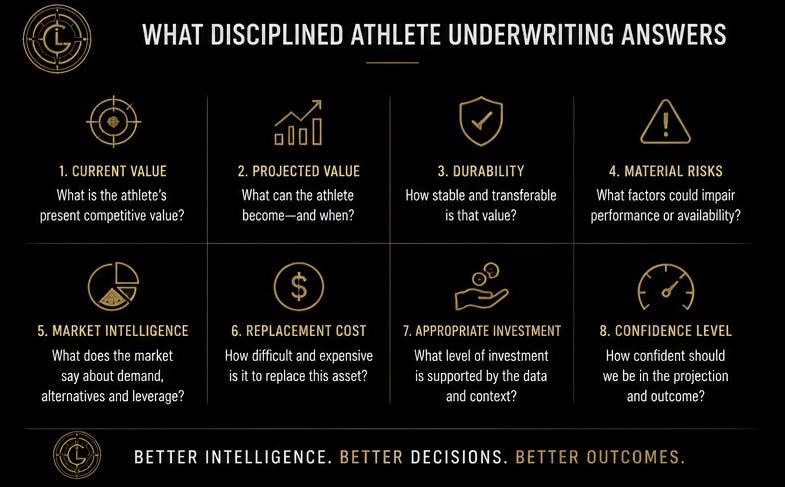
At minimum, it should answer:
1. What is the athlete’s current competitive value?
Not reputation.
Not recruiting ranking.
Not social-media perception.
What does the athlete currently provide based on verified performance, traits, role and level of competition?
2. What is the athlete’s projected value?
What can the athlete realistically become?
What development must occur?
How long is that development likely to take?
What evidence supports the projection?
3. How durable is the athlete’s value?
Is the value dependent on a single trait, system, coach, or temporary market condition?
Does the athlete possess characteristics that are likely to translate across environments?
4. What are the material risks?
Where could the projection fail?
The answer may involve development, academics, role fit, positional value, market timing, retention exposure, decision-making, or other nonmedical risk factors.
5. What does the market say?
How much demand is there for the position?
What alternatives are available?
How does the athlete compare with those alternatives?
What leverage does the athlete or institution actually possess?
6. What is the replacement cost?
How difficult would it be to replace the athlete’s expected contribution?
What financial, developmental, and competitive resources would replacement require?
7. What is the appropriate level of investment?
Should the program recruit, retain, compensate, develop, replace, or pass?
Underwriting should not merely describe the athlete.
It should support the decision.
8. How confident should the institution be?
Every projection contains uncertainty.
A credible underwriting process must clearly communicate the confidence level, assumptions, and variables that could change the recommendation.
The absence of certainty is not the problem.
Unpriced uncertainty is.
The Need for an Independent Intelligence Layer
Coaches should continue to coach.
Scouts should continue to evaluate.
General managers should continue to build rosters.
Athletic directors should continue to set institutional priorities.
But when millions of dollars, roster spots and long-term competitive outcomes are involved, the decision should not depend exclusively on the people whose employment, reputation or previous evaluations are connected to the outcome.
College athletics needs an independent source capable of evaluating the athlete without needing to justify the recruitment, preserve the relationship, protect a ranking or close the transaction.
That independent source should not ask:
How badly do we want this athlete?
It should ask:
What does the evidence support?
That is the role L.I.G. Sports Intelligence is building to serve.
Introducing Athlete Asset Underwriting™
L.I.G. Sports Intelligence has developed and continuously refines an Athlete Asset Underwriting™ methodology designed to assess athlete value, market position, durability, development trajectory, and risk before making financial, competitive, or career decisions.
The methodology combines:
Film-based athletic evaluation
Market intelligence
Positional value
Developmental projection
Athlete risk analysis
NIL readiness
Replacement-cost considerations
Independent decision support
The objective is not to create another ranking.
The objective is to produce a clearer view of the asset, the exposure and the decision.
For athletes and families, that intelligence can improve recruiting, development, NIL and career choices.
For athletic departments, it can support recruiting, retention, compensation and roster construction.
For agencies, insurers, lenders and other entities with financial exposure to athlete performance or future earnings, it can provide the athletic intelligence layer that traditional financial models may not fully capture.
The same central question applies to every buyer:
What are we actually underwriting before we commit our money, opportunity or future to this athlete?
College Athletics Must Catch Up to Its Own Economics
College athletics has already accepted athlete compensation.
It must now accept the discipline that compensation requires.
You can't run a multimillion-dollar athlete market with a model that only determines scholarship offers. School leaders need to adopt the decision-making approach of professional sports team owners, who make independent personnel decisions. While they still evaluate players, owners with significant financial stakes often rely on independent underwriters for additional insight to avoid reactive and poor decisions.
You cannot treat retention as a capital decision while relying solely on internal advocacy.
You cannot manage a roster portfolio without understanding scarcity, replacement cost, value durability, and downside risk.
And you cannot claim to allocate resources strategically if no independent process exists to challenge the assumptions underlying the allocation.
The athlete economy has changed.
The intelligence used to evaluate athlete assets must change with it.
College athletics does not merely have a recruiting problem.
It has a capital-allocation problem.
Athlete Asset Underwriting™ is the missing discipline.
About Blue Chip Academy
Blue Chip Academy is the media and education platform of L.I.G. Sports Intelligence, providing analysis on athlete value, risk, recruiting, NIL and the changing economics of sports.
About L.I.G. Sports Intelligence
L.I.G. Sports Intelligence provides independent Athlete Asset Underwriting™, strategic advisory and decision intelligence to athletes, families, athletic departments and organizations with financial or competitive exposure to athlete value.
Intelligence before capital is committed.